
Trees
Mammee Apple
Mammea americana
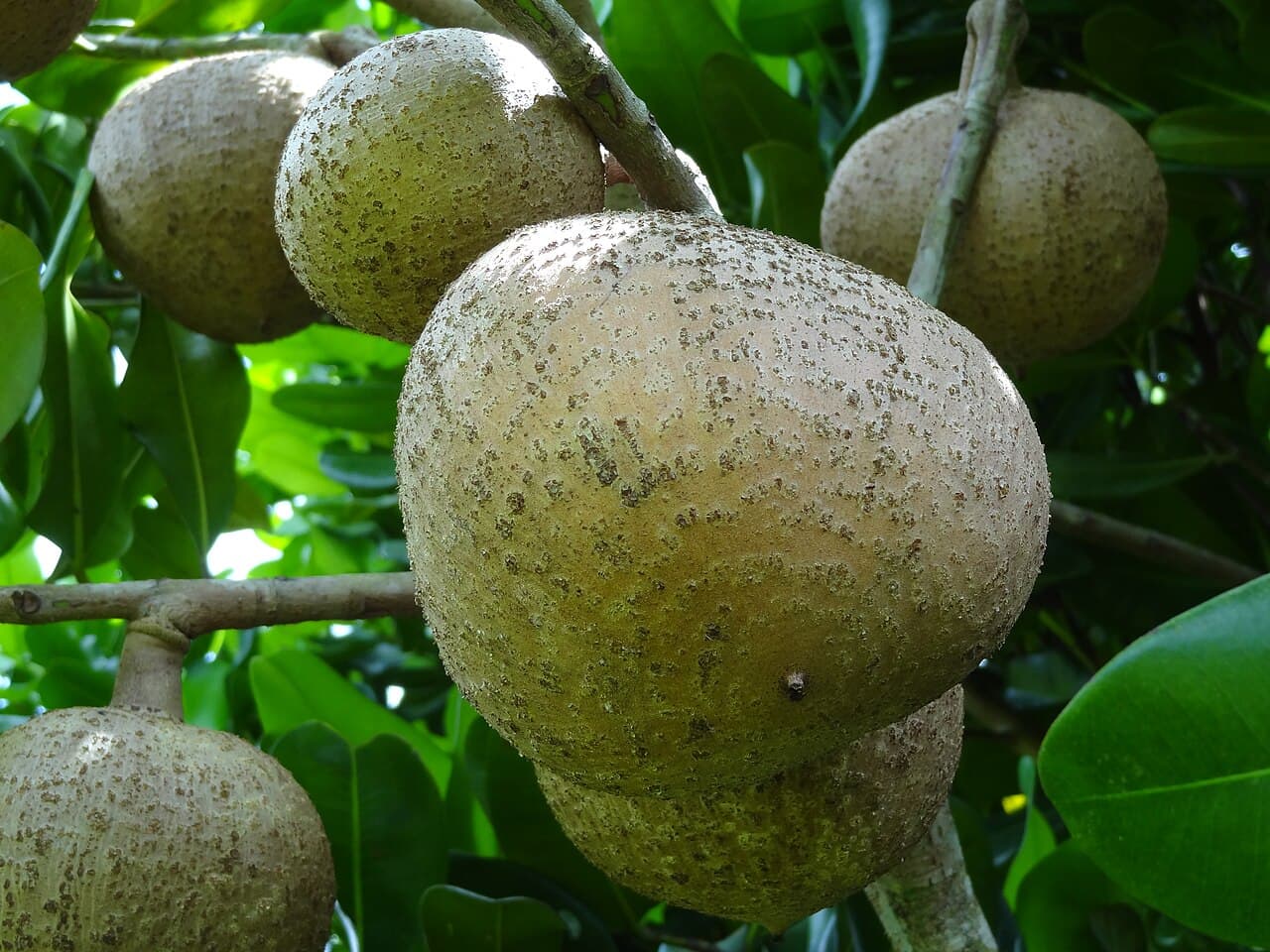
Photo: Wikimedia Commons contributor · Guadeloupe (CC BY-SA 3.0)
The Mammee Apple is a handsome native fruit tree of the Caribbean, producing one of the region's most distinctive fruits: a large, russet-skinned sphere with fragrant, golden-orange flesh that tastes faintly of apricot and vanilla. Once common in the forests and home gardens of Trinidad and Tobago, mature wild trees are now less frequently encountered, though it remains a beloved part of the local fruit heritage and a tree of genuine ecological and cultural depth.
Description
A large, stately evergreen tree reaching 18 to 25 metres in good conditions, with a dense, symmetrical crown and straight trunk. Bark is grey-brown, rough, and exudes a yellow-orange, sticky latex when cut. Leaves are large, leathery, oval, and deep glossy green. Flowers are small, white, four-petalled, and intensely fragrant, borne in clusters on the branches; they are among the most pleasantly scented flowers of any Caribbean tree. The fruit is large, 10 to 20 cm across, with a rough, brown outer skin, a thin bitter inner skin, and 1 to 4 large seeds embedded in the golden flesh.
Uses and Cultural Notes
The fragrant flowers of the Mammee Apple have been used across the Caribbean to make mammee liqueur, a rum-based infusion once common in Trinidad. The fruit is eaten fresh, made into jam, or cooked in syrup. The seed kernel yields a toxic oil (mammee oil or oil of Talauma) that was historically used as an insecticide and in treatments for skin parasites and mange in livestock; it is poisonous if ingested. The timber is reddish-brown and durable, used for furniture and construction in parts of its range. In T&T the tree is associated with older estate gardens and traditional home orchards; it is rarely planted commercially today.
Ecology
Mammee Apple is native to the Caribbean and is considered indigenous to Trinidad and Tobago. In the wild it grows in lowland and lower-montane moist forest, often on well-drained slopes and forest edges. The fruits are eaten by a range of wildlife including parrots, toucans, and larger mammals. The tree is slow-growing but long-lived; old specimens can be impressive in size and form. It is tolerant of partial shade when young and establishes well in the understory before growing up to the canopy.
Threats
- Decline in home orchard planting
- Forest clearance
- Slow regeneration