Trees
Guava
Psidium guajava
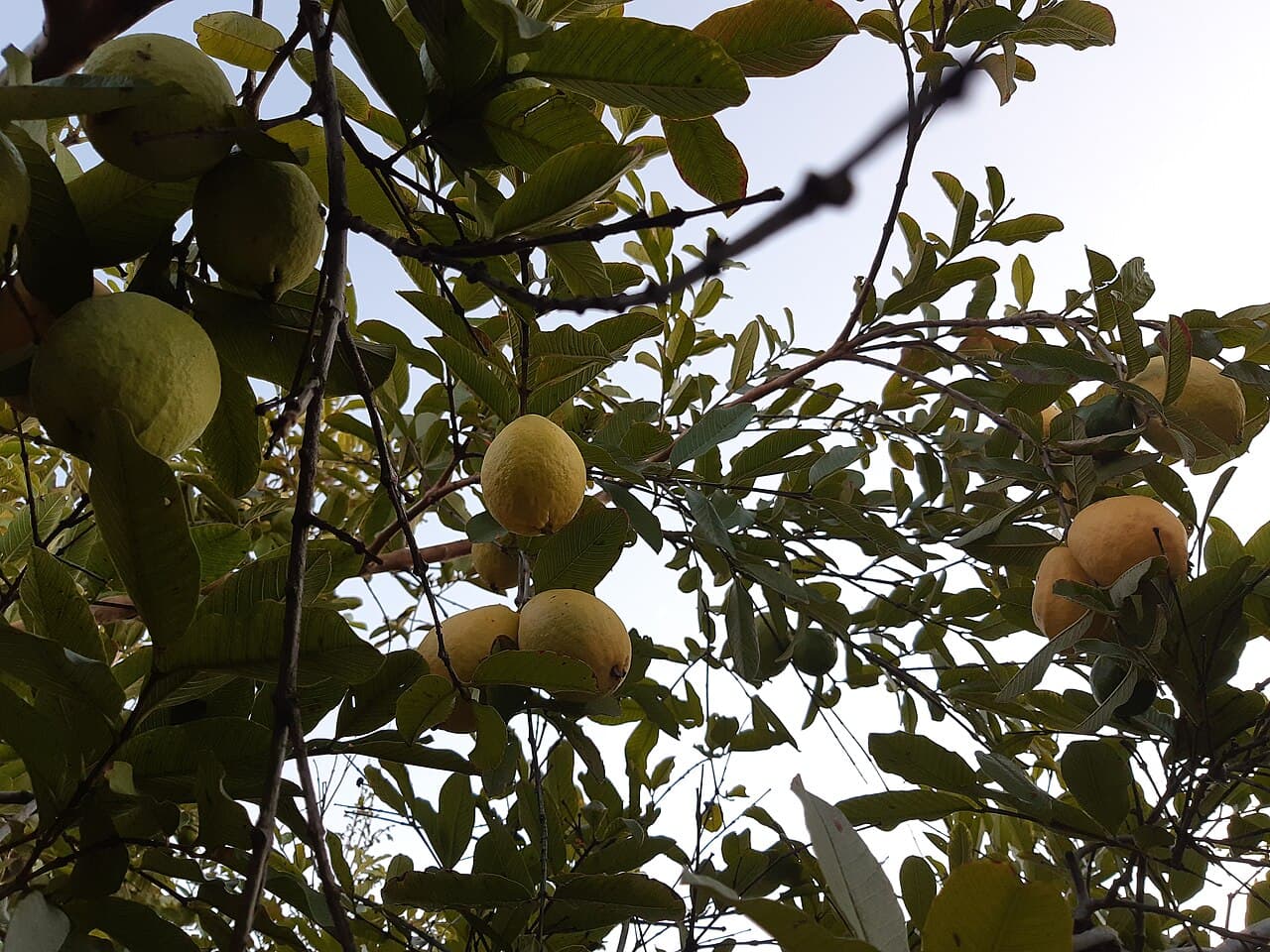
Photo: Wikimedia Commons contributor (CC BY-SA 4.0)
Guava is one of the most ecologically significant pioneer trees of Trinidad and Tobago's disturbed and secondary landscapes. Native to tropical America and long established across the Caribbean, it is a prolific fruiter whose berries sustain an extraordinary range of birds and mammals year-round, making it a keystone species in fragmented and recovering forest. Its abundance, rapid growth, and sweet fruit make it both a cornerstone of local food culture and a vital ecological resource.
Description
A shrub to small tree, typically 3 to 8 metres tall, with a multi-stemmed, spreading form. The bark is one of the tree's most distinctive features: smooth, thin, and pale green to copper-brown, peeling in thin flakes to reveal a greenish under-layer. Leaves are oval, leathery, prominently veined, and aromatic when crushed. Flowers are white with numerous stamens, produced throughout the year. Fruit is round to pear-shaped, 4 to 12 cm across, with a thin yellow-green to yellow skin, and white, pink, or salmon-coloured flesh that is granular, seedy, and strongly fragrant.
Ecological Role
Guava is an ecological workhorse of Trinidad and Tobago's secondary habitats. The fruits are consumed by a wide array of species: toucans, parrots, tanagers, thrushes, pigeons, bats, monkeys, agoutis, and porcupines all feed on them, and by doing so disperse seeds widely through forest edges and disturbed ground. This fruit-wildlife relationship makes guava an important driver of forest regeneration in degraded areas. It grows rapidly in full sun and tolerates poor, rocky, and seasonally dry soils, establishing quickly on roadsides, pasture margins, and abandoned agricultural land.
Uses
Guava is one of the most widely used fruits in Trinidad and Tobago's culinary tradition. Guava cheese (a dense fruit paste), guava jam, guava juice, and stewed guava are staple preparations in Trinidadian and Tobagonian kitchens. The leaves are used in traditional medicine for diarrhoea and as an antiseptic wash. The wood, though small in dimension, is hard and dense and has been used for tool handles and turned objects. The tree is harvested from the wild and from home gardens; it is rarely formally cultivated at commercial scale in T&T.
Threats
- No conservation concern
- Removed from agricultural land as weed tree