
Trees
Calabash Tree
Crescentia cujete
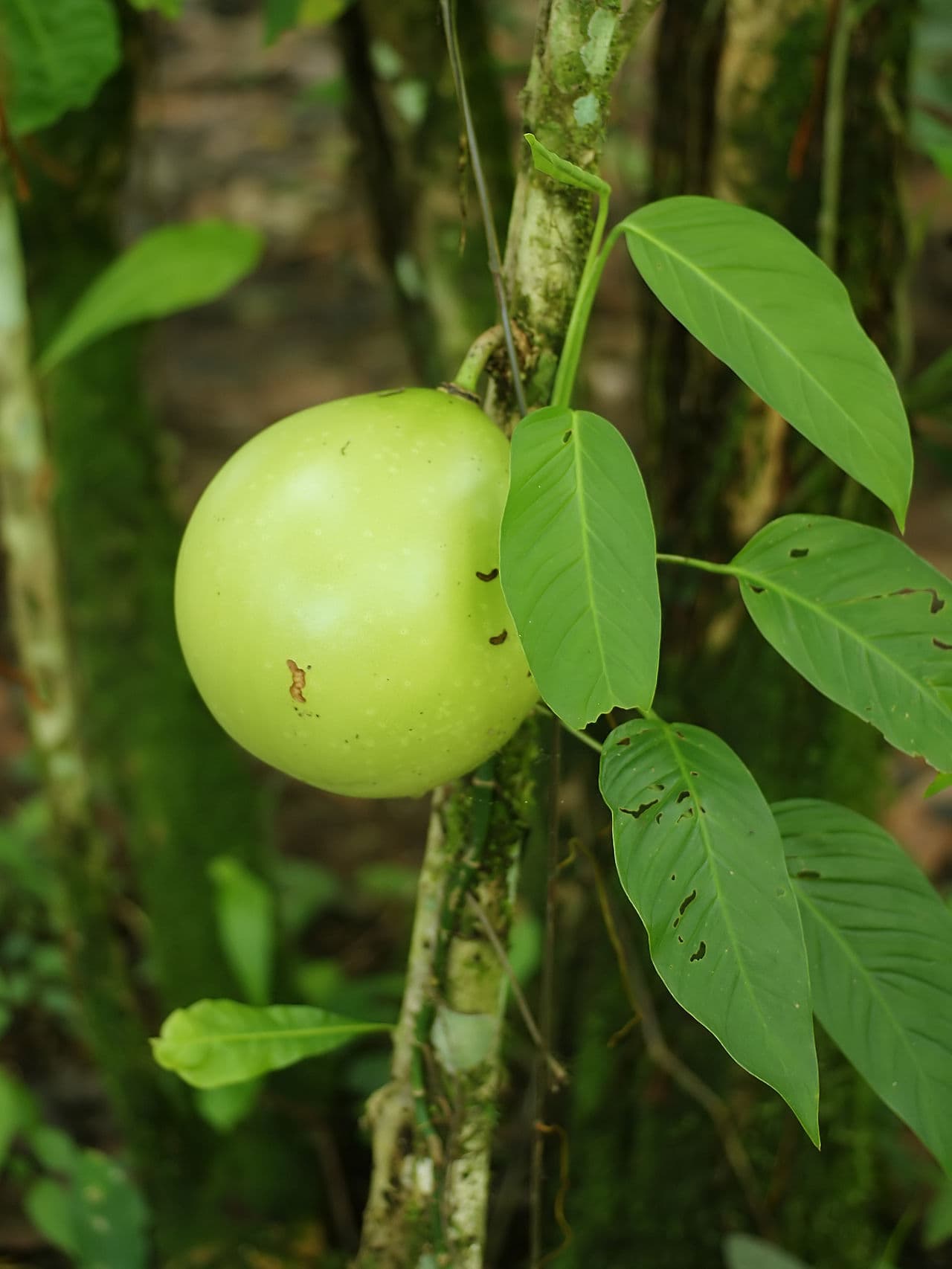
Photo: Hans Hillewaert · Puerto Viejo de Sarapiqui, Costa Rica (CC BY-SA 4.0)
The Calabash Tree is one of the most culturally embedded trees in Trinidad and Tobago, its large, round, hard-shelled fruits providing the raw material for maracas, bowls, cups, ladles, and fishing floats that have been in use since the time of the island's first peoples. A medium-sized, wide-spreading tree common in home gardens, forest edges, and riverbanks, it is immediately recognisable by the way its strange, pale flowers and enormous gourds grow directly from the trunk and main branches.
Description
A semi-evergreen tree typically reaching 8 to 10 metres, with a broad, irregular crown and low, spreading branches. The bark is grey-brown and slightly roughened. Leaves are spatula-shaped, clustered in rosettes along the branches. The flowers are remarkable for their placement: they emerge directly from the trunk and main limbs (a habit called cauliflory) rather than from branch tips, appearing as pale yellow-green, veined, night-blooming blooms pollinated by bats. The fruit is the tree's defining feature: a large, round to oval gourd, 15 to 30 cm in diameter, with a smooth, hard, green shell and a thick, fibrous white pulp surrounding the seeds.
Cultural Significance
Few trees in T&T carry as much cultural weight as the Calabash. The dried, hollowed-out shell has been used by Amerindian peoples and their successors for millennia as a vessel, musical instrument, and tool. The maraca, one of the defining instruments of both traditional and popular Caribbean music, is made from the dried calabash shell filled with seeds or beads. Calabash shells are carved, painted, and sold as craft items throughout the islands. The pulp, though not edible raw, is used in traditional medicine as a purgative and in remedies for respiratory complaints. The tree is commonly planted near homes specifically to harvest the fruit for these uses.
Ecology
Calabash trees are found in a range of lowland habitats: river margins, forest edges, secondary scrub, coastal areas, and home gardens. The bat-pollinated flowers open at night and produce nectar attractive to a range of bat species. The large, heavy fruits fall to the ground when ripe and are gnawed at by rodents seeking the seeds, providing a dispersal pathway. The tree tolerates seasonal flooding and dry periods, making it a reliable component of riparian vegetation. It is not considered invasive and is generally regarded as a native or long-naturalised species across the Caribbean.
Threats
- Widely planted; low conservation concern
- Gradual garden replacement