
Orchids
Butterfly Orchid
Psychopsis papilio
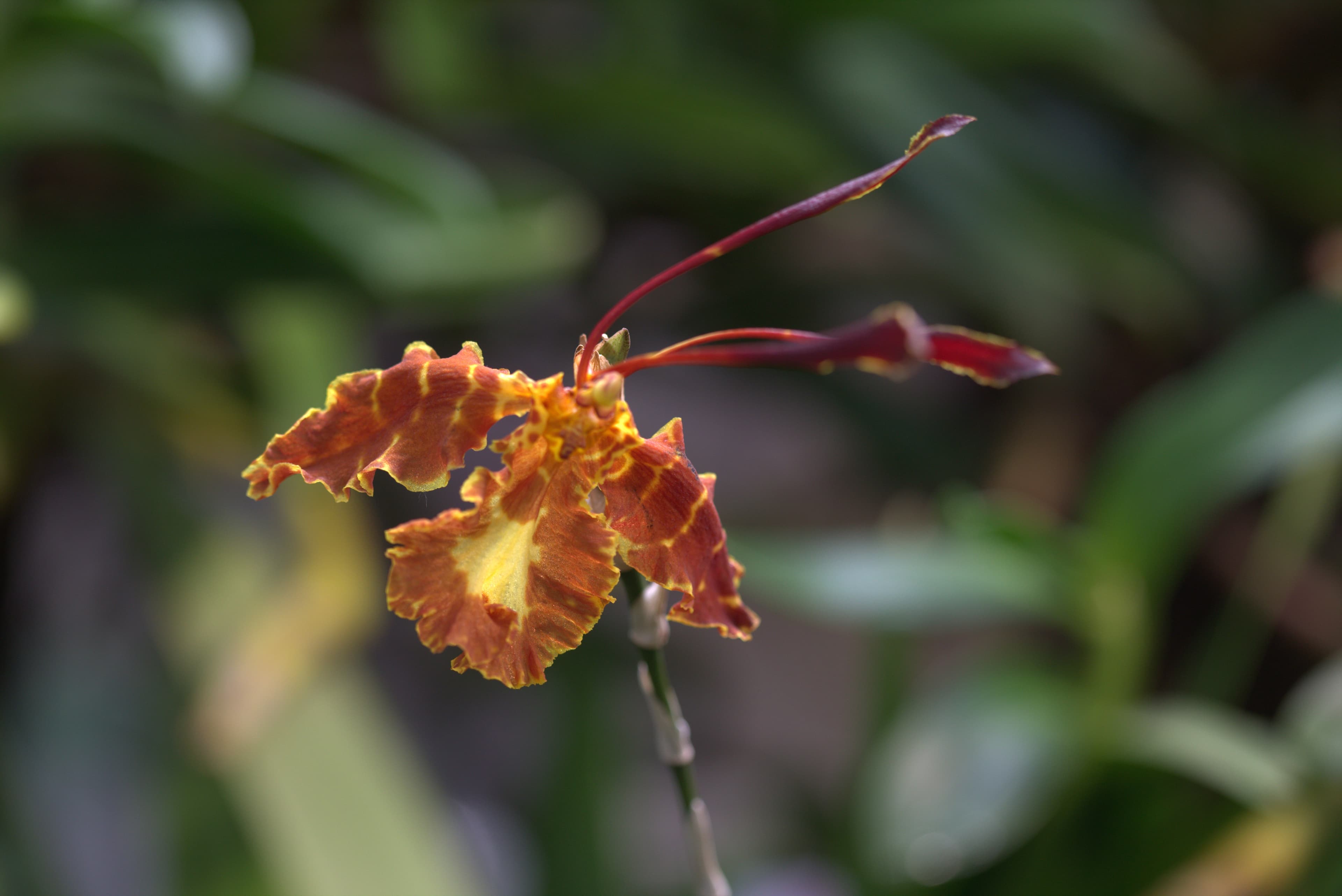
Photo: Averater · Gothenburg Botanical Garden (CC BY 3.0)
The Butterfly Orchid produces what are arguably the most convincingly insect-like flowers of any plant: a single bloom at a time on a long spike, its chestnut and gold-dappled sepals spread like wings and its bright yellow lip mimicking a body, the whole effect so convincing that bees are deceived into approaching it as they would a rival or a mate. Found in humid montane forest in Trinidad, it is near-endemic to the island and is credited in orchid history with helping to ignite the 19th-century collecting frenzy known as orchid mania.
Description
An epiphytic orchid growing at mid-elevation in humid tropical forest. The flowers are strikingly butterfly-like: two narrow, erect upper petals resemble antennae; two broad lateral sepals, heavily mottled in golden yellow and chestnut brown, spread like wings; and the labellum (lip) is typically solid bright yellow, sometimes with purple spots or markings, representing an insect body. Individual flowers are large and are produced one at a time from a tall flowering spike. Uniquely, the spike does not die after the first flower fades but continues to produce successive blooms sequentially over many months, making it exceptionally long-flowering in cultivation and presumably in the wild.
Habitat and Range
Psychopsis papilio grows epiphytically in humid tropical forest at approximately 800 to 1,200 m elevation. In Trinidad it occupies the Northern Range montane forest zone. The global range extends from Trinidad through Panama, Colombia, Venezuela, Suriname, French Guiana, and into Brazil. Trinidad is at or near the northern edge of its natural range; T&T populations may represent a genetically distinct northern component. Tobago distribution has not been confirmed in accessible sources.
Pollination
Despite the convincing butterfly appearance of the flowers, pollination is carried out by bees rather than butterflies. The precise mechanism is not fully confirmed in the literature, with hypotheses ranging from sexual deception (male bees attempting to mate with what appears to be a female insect) to territorial defence mimicry (male bees attacking what appears to be a rival). The specific pollinator species for T&T populations has not been published in sources accessible during research.
Historical Significance
Psychopsis papilio was described by John Lindley from living material as Oncidium papilio, and the genus Psychopsis was later re-established to accommodate it and close relatives. It is widely cited in orchid history as one of the tropical orchids that, when displayed blooming in Europe in the early 19th century, helped ignite the era of "orchid mania" (orchidelirium): the competitive frenzy among wealthy collectors to acquire and display tropical orchids that defined Victorian-era horticulture. The species' capacity to rebloom sequentially on the same spike made it a remarkable display plant.
Legal Protection
As a member of Orchidaceae, Psychopsis papilio is covered by the CITES Appendix II family-level listing. International trade in wild-collected specimens requires export permits from the country of origin. No confirmed individual listing under Trinidad and Tobago's domestic legislation was found in available sources; collection from State forests is regulated under the Forests Act.
Threats
- Wild collection
- Habitat loss
- Montane forest clearance