Trees
Bois Immortelle (Mountain Immortelle)
Erythrina poeppigiana
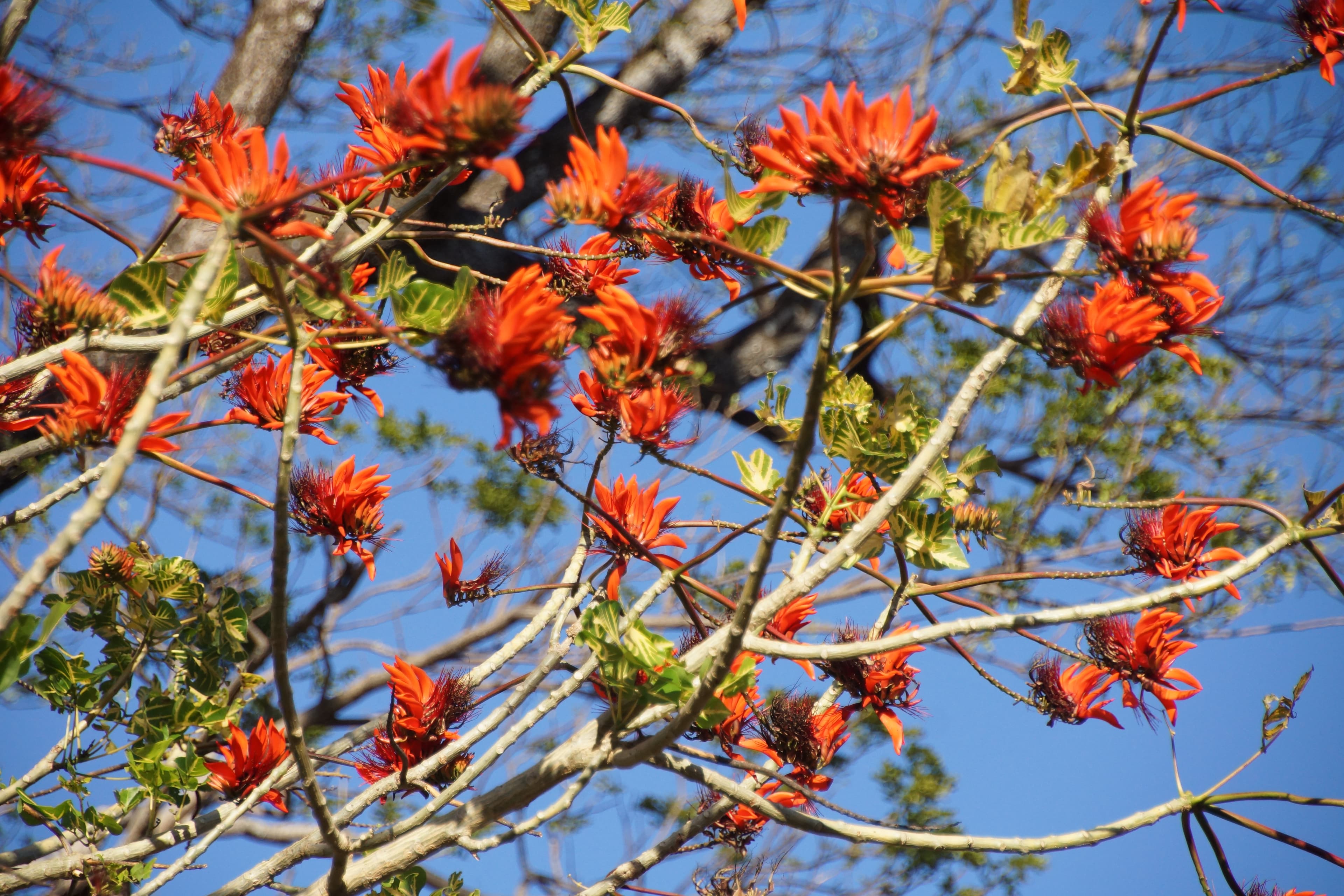
Photo: Rob Stoeltje · Costa Rica (CC BY 2.0)
The Bois Immortelle is one of the most iconic trees in Trinidad, its brilliant orange-red flowers blazing across the Northern Range hillsides every dry season from January to March, overlapping with Carnival and marking the landscape of the old cocoa estates. Introduced from South America as a shade tree for cocoa and coffee, it became inseparable from the culture and ecology of Trinidad's cocoa belt.
Description
A large semi-deciduous tree reaching up to 35 metres in height, with a trunk diameter of up to 2 metres. The bole can be branch-free for 10 to 20 metres and the bark bears thorn-like protuberances. Leaves are trifoliate (three-leaflet compound), dark green, and shed briefly before flowering. The flowers are large, brilliant orange-red, and borne in upright racemes on bare or nearly bare branches, making the tree unmistakeable in full bloom. Fruit are legume pods containing seeds that carry toxic erythrina alkaloids.
Habitat and Ecology
In Trinidad, the Bois Immortelle is found primarily across the Northern Range foothills and mid-elevation estates, where it was planted extensively as a shade canopy for cocoa and coffee from the 18th century onward. It thrives in humid to subhumid conditions, tolerating a wide range of soils, and can grow from lowland sites to around 2,000 metres elevation. As a legume, it forms root nodules with nitrogen-fixing Bradyrhizobium bacteria, contributing substantially to soil fertility; studies have recorded nodule densities exceeding 1,000 kg per hectare. Research conducted in Trinidad and Tobago (Feinsinger et al., 1979) found that passerine birds and the bananaquit (Coereba flaveola) are important pollinators, visiting the nectar-rich flowers alongside hummingbirds. Inflorescences are protected from nectar thieves by extrafloral nectaries that recruit belligerent ants. Seeds are buoyant and can be dispersed by water.
Cocoa Estates and Cultural Significance
The Bois Immortelle was the defining shade tree of Trinidad's cocoa industry. Planted in rows across estates throughout the Northern Range, it created the iconic three-layer landscape of cocoa: immortelle canopy above, cocoa trees in the mid-story, and ground crops below. Its annual dry-season flowering, brilliant orange on bare branches, became embedded in Trinidadian cultural identity. The French Creole name "bois immortelle" (immortal wood) reflects both its remarkable resilience and its annual, seemingly undying, blaze of colour. The blooming of the Immortelle during the Carnival season has made it one of the most emotionally resonant trees in T&T. As shade-grown cocoa declines, the presence of Immortelle trees across the Northern Range is diminishing.
Uses
Beyond shade provision, the Bois Immortelle is used in agroforestry as a living fence and as green manure: its nitrogen-rich prunings decompose rapidly, improving soil fertility. It has been used in alley-cropping systems, living windbreaks, and as an ornamental street tree in many tropical countries. The soft, light timber has limited structural value but is used for crates, pencils, and low-value wood products. All parts of the plant, especially the seeds, are toxic to humans and livestock due to erythrina alkaloids.
Threats
- Decline of shade-grown cocoa
- Agricultural intensification
- Estate abandonment
- Land conversion