Mangroves
Black Mangrove
Avicennia germinans
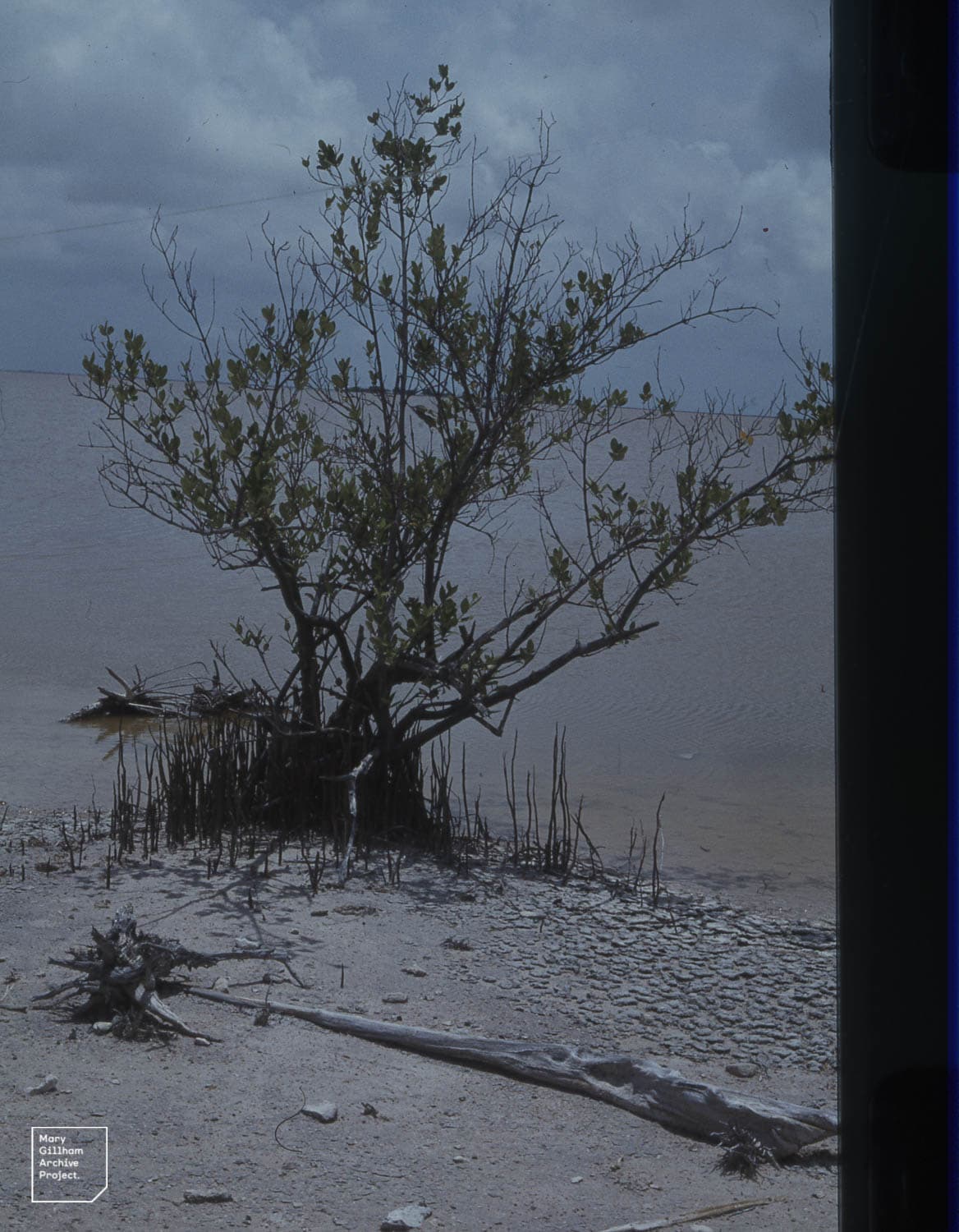
Photo: Dr Mary Gillham Archive Project · Windsor Lake, Inagua, Bahamas (CC BY 2.0)
The Black Mangrove grows in the landward zone of Trinidad and Tobago's coastal wetlands, behind the Red Mangrove fringe, tolerating higher salinity and drier conditions than most mangrove species. It is immediately identifiable by the thousands of pencil-like breathing roots (pneumatophores) that project vertically from the mud around its base, and by the salt crystals that form on its leaves as it actively excretes seawater through specialised glands.
Description
An evergreen tree or large shrub typically 3 to 12 metres tall, occasionally reaching 25 metres. The bark is dark grey-brown to almost black (hence the common name) and contains around 12.5% tannin, historically exploited for leather tanning and reddish dyes. Leaves are opposite, elliptic, and waxy; the upper surface is dark green and the underside silvery-grey. Salt-excreting glands on both leaf surfaces actively remove excess salt, and white crystals are commonly visible on the leaves. Flowers are small, white to pale yellow, tubular, and fragrant; they produce quality nectar exploited by bees for honey. The most distinctive feature is the pneumatophores: dense stands of vertical pencil-like roots that emerge from the mud in a broad apron around each tree, supplying oxygen to the root system buried in anaerobic sediment.
Habitat and Ecology
Black Mangrove occupies the landward zone of mangrove swamps, positioned behind the Red Mangrove fringe and tolerating the more hypersaline and periodically drier conditions found there. It grows on muddy, sandy, or gravelly tidal substrates in sheltered estuaries, lagoons, and river mouths. In T&T it is present at Caroni Swamp and Nariva Swamp, both Ramsar Sites of international importance, and at other coastal wetlands. Pneumatophores provide substrate for algae, invertebrates, and juvenile fish, extending the nursery habitat function of the root zone into the water column. The tree also contributes to coastal carbon storage ("blue carbon"): mangrove soils accumulate organic matter at high rates, locking away carbon in peat.
Legal Protection
Caroni Swamp is designated a Wildlife Sanctuary under the Conservation of Wildlife Act (Chap. 67:01) and a Ramsar Wetland of International Importance (Ramsar site 1655). Nariva Swamp is designated a Managed Resource Protected Area under the Environmentally Sensitive Areas Rules 2001 (under the Environmental Management Act) and a Ramsar Wetland of International Importance (Ramsar site 1654). Mangrove clearance within these areas is prohibited and can attract criminal penalties. The Forests Act (Chap. 66:01) also restricts felling in State forest reserves. The Environmentally Sensitive Species Rules 2001 currently schedule only fauna; no individual plant species including Black Mangrove are listed. Protection is therefore primarily habitat-level rather than species-level.
Uses and Traditional Knowledge
Black Mangrove bark has been used for centuries in tanning leather and as a source of reddish dye. The dense, hard wood has served as pilings, posts, charcoal, and firewood. Smoke from the wood is traditionally used to repel mosquitoes in some communities. Medicinal uses are documented across the species' range for skin complaints, as a childbirth aid, and for intestinal ailments. The flowers are an important apiary resource, producing high-quality honey in coastal areas.
Threats
- Coastal development
- Sea-level rise
- Pollution and runoff
- Illegal felling