
Ferns
Bird's-nest Fern
Asplenium nidus
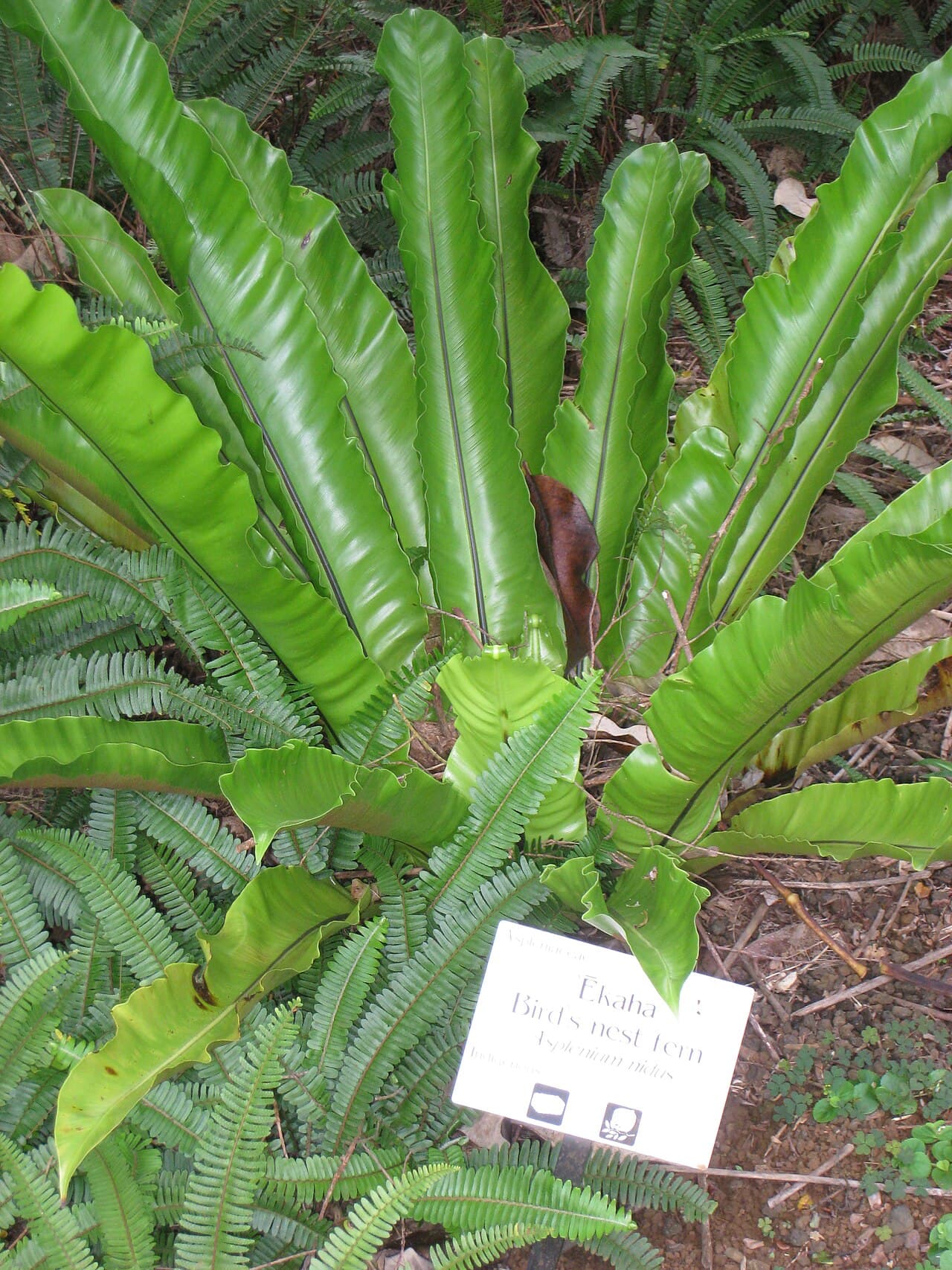
Photo: Daderot · Lyon Arboretum, Hawaii (Public Domain)
The Bird's-nest Fern is one of the most immediately recognisable plants of Trinidad and Tobago's moist rainforests: a large epiphytic fern whose undivided, strap-like fronds radiate from a central rosette in a pattern that perfectly mimics a giant bird's nest. The central cup fills with fallen leaves, bark, and debris that decompose into a self-fertilising compost, making the plant ecologically self-sufficient and capable of reaching impressive size high in the rainforest canopy.
Description
A large epiphytic or occasionally terrestrial fern forming a funnel-shaped rosette of simple, undivided fronds. Fronds are bright, glossy green, strap-like, 50 to 150 cm long and 8 to 20 cm wide, with a prominent dark midrib and slightly wavy margins. The central rosette has a dark, spongy, nest-like core of old frond bases and accumulated debris. Spores are produced in long, linear sori running parallel to the veins along the inner half of the frond underside - quite different from the round sori typical of most ferns. New fronds emerge tightly coiled from the centre and gradually unfurl.
Ecology
Bird's-nest Ferns are characteristic of humid, shaded rainforest, growing on tree trunks, in branch forks, and occasionally on rocks or the forest floor in particularly moist sites. They are most common in the mid and lower canopy of Trinidad's Northern Range forest. The central nest collects and retains organic matter, fallen leaves, insects, and moisture, creating a self-sustaining microhabitat. This accumulated material supports a community of invertebrates including insects, millipedes, and small frogs that shelter within the rosette. The spongy nest material also provides nesting substrate for some bird species in the canopy.
Cultivation
Bird's-nest Fern is one of the most popular ornamental ferns in Trinidad and Tobago's gardens, widely grown in pots, hanging baskets, and as a landscape plant in shaded spots. It tolerates lower light levels than most ornamental plants and is relatively easy to maintain in humid tropical conditions. Collection of wild plants for the ornamental trade has historically been a pressure on populations in accessible forest, though nursery-grown specimens are now widely available.
Threats
- Wild collection for ornamental use
- Loss of mature canopy trees
- Forest fragmentation reducing humidity