Trees
Balata
Manilkara bidentata
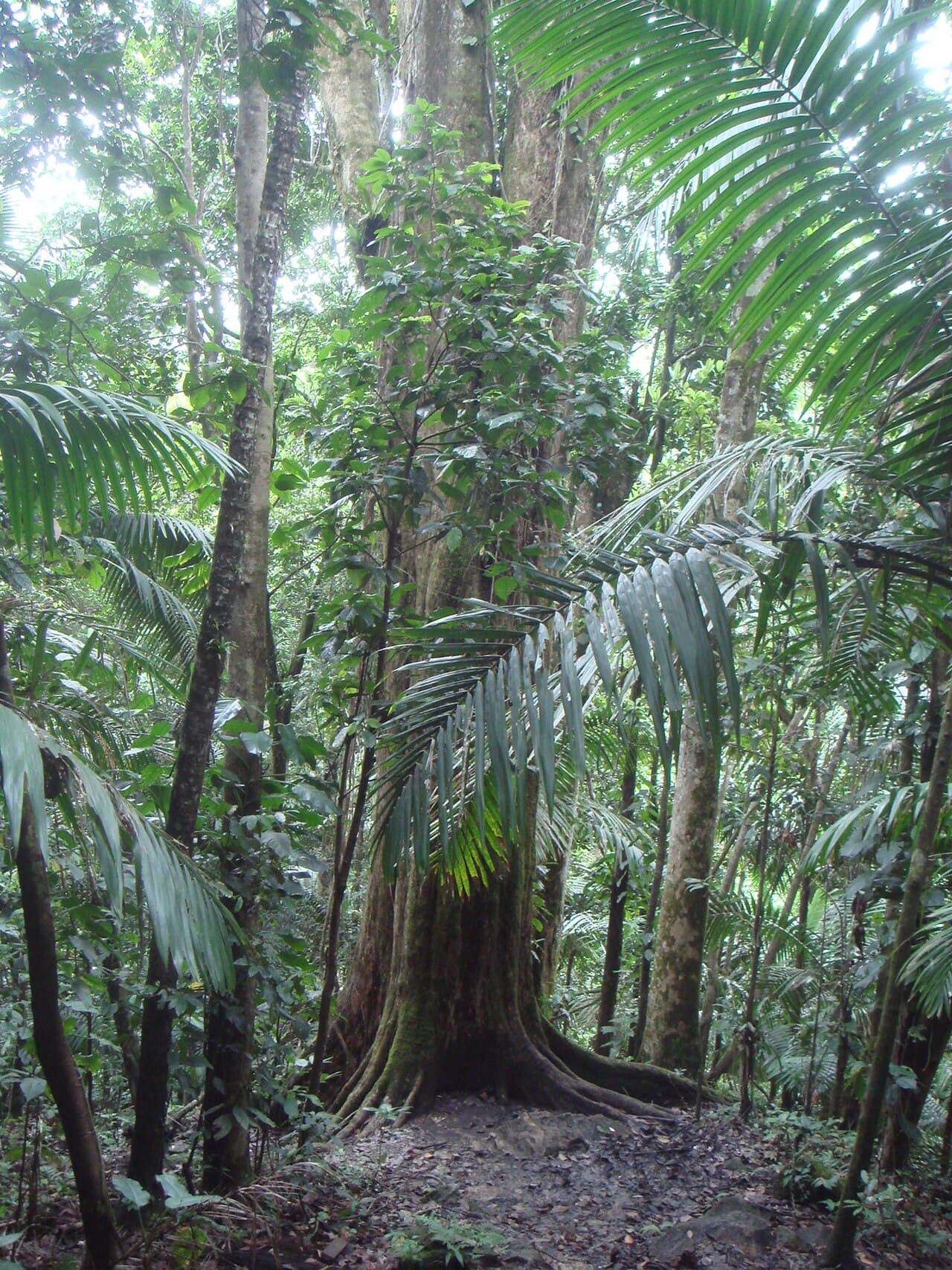
Photo: Wikimedia Commons contributor (CC BY-SA 3.0)
The Balata is among the tallest and most commercially significant hardwood trees of Trinidad and Tobago's rainforests. Prized for its extraordinarily dense, durable timber and the natural latex (balata gum) tapped from its trunk, it was once so heavily exploited that significant stands were cleared. Remaining mature individuals are now concentrated in Forest Reserves, where they stand as towering anchors of the old-growth canopy.
Description
A large evergreen tree typically reaching 30 to 40 metres, occasionally taller, with a straight cylindrical bole that can exceed one metre in diameter. The crown is dense and spreading. Bark is dark brown, rough, and deeply fissured, exuding white latex when cut. Leaves are leathery, oblong to elliptic, dark green above and paler below. Small, cream-coloured flowers are borne in clusters along the branches. The fruit is a small, fleshy berry containing one to three hard, shiny brown seeds with a distinctive lateral groove on each side, giving rise to the species name bidentata (two-toothed).
Ecology and Uses
Balata is a canopy dominant in moist and wet lowland and lower-montane rainforest. It is a keystone species for frugivores: the ripe berries are eaten by toucans, parrots, monkeys, and other animals, making it a significant food source within forest communities. The latex, harvested by tapping the trunk in a pattern of diagonal cuts, was commercially important in the late 19th and early 20th centuries as a substitute for gutta-percha, used in insulating submarine telegraph cables and in golf balls. The timber, sold as bulletwood or balata in the international trade, is one of the hardest and heaviest in the Americas, historically used for shipbuilding, bridge construction, and heavy industrial flooring.
Conservation
Decades of logging for both timber and latex extraction reduced Balata populations significantly across the Caribbean. In Trinidad and Tobago, remaining stands are primarily within designated Forest Reserves and are subject to the Forests Act. Commercial harvesting requires a permit from the Forestry Division. The species is not listed on CITES but is considered commercially threatened in parts of its range. Large old-growth individuals are now rare outside protected areas.
Threats
- Historical over-exploitation
- Illegal logging
- Slow regeneration rate