Reptile
Cloudy Snake
Sibon nebulata nebulata
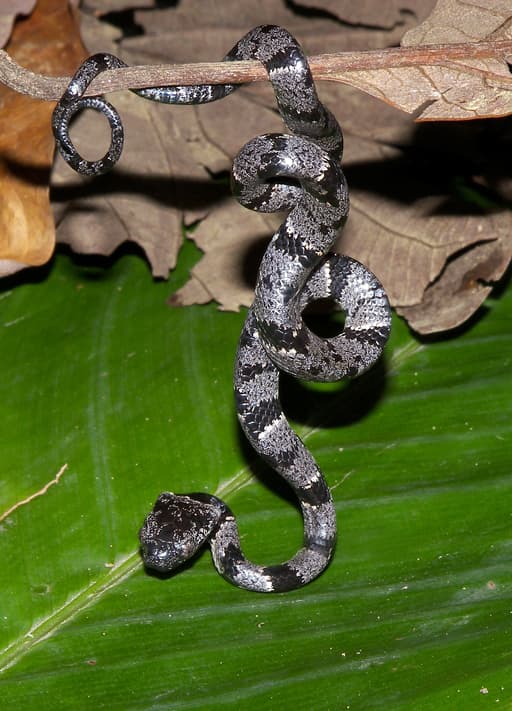
The Cloudy Snake is an arboreal, nocturnal dipsadine colubrid found on both Trinidad and Tobago. Like the Snail-Eating Snake (Dipsas variegata), it has evolved specialised jaw anatomy to feed on molluscs, primarily slugs and snails. Its mottled brown and cream pattern provides excellent camouflage on bark and lichen during the day when it rests motionless on branches. Completely harmless to humans.
Description
Sibon nebulata nebulata is a slender, moderately sized snake reaching approximately 50 to 75 cm. The body is irregularly mottled or "clouded" in shades of grey, brown, beige, and cream, producing a complex pattern that mimics bark texture and lichen cover with remarkable fidelity when the snake is pressed against a branch during its daytime rest. The head is distinct from the neck with large, protuberant eyes that face partially forward, enhancing binocular vision for three-dimensional depth perception in the understorey at night.
Ecology
Primarily arboreal and strictly nocturnal, the Cloudy Snake feeds on terrestrial and arboreal slugs and snails. Like the related Dipsas, it has mobile lower jaw elements that allow it to insert the jaw into a snail shell and hook the snail body free while the shell rotates. This technique requires no strength, only precision; the entire apparatus is adapted for the task of extracting soft molluscs from coiled shells with minimal effort. Slugs, which require no extraction, are simply seized and swallowed.
Conservation
The Cloudy Snake belongs to the genus Sibon, which is entirely molluscivorous, feeding only on slugs, snails, and slugs in the New World tropics. The genus is convergent with the South American Dipsas and the broader dipsadine clade that has independently evolved molluscivory multiple times. The subspecies nebulata occurs from Mexico through Central America and across the Caribbean to Trinidad and Tobago. It is fully protected under the Conservation of Wildlife Act.
Threats
- Habitat loss and forest fragmentation
- Decline of land snail and slug populations in degraded habitats