
Reptile
Checkerbelly
Siphlophis cervinus
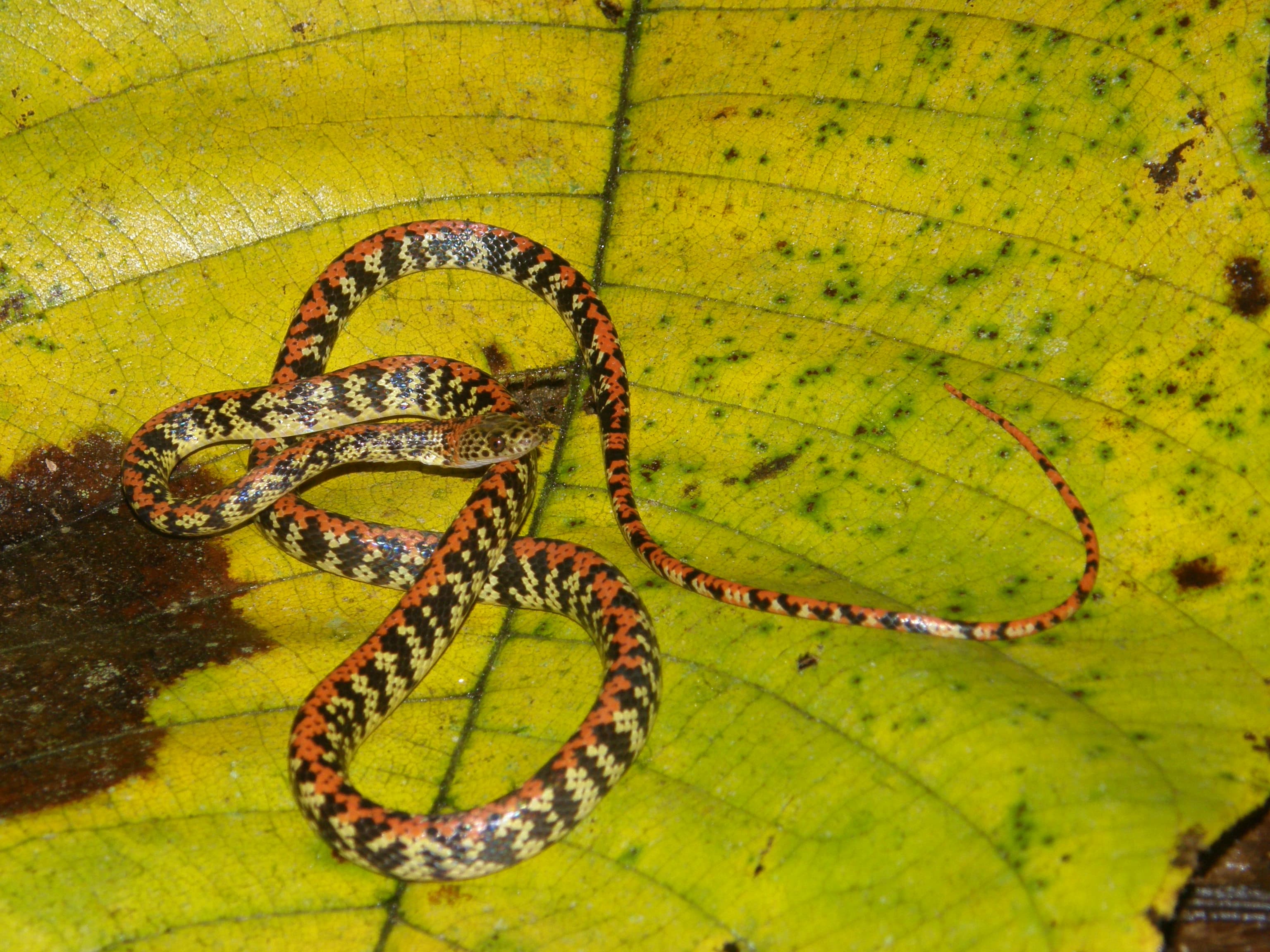
The Checkerbelly is a slender, arboreal colubrid found in forest habitats on Trinidad. Named for the distinctive black and white or black and cream checkered pattern on its belly, it is a nocturnal specialist hunter of sleeping lizards. Rear-fanged but entirely harmless to humans, it is one of several small T&T snakes that exploit the vulnerability of lizards that enter a stupor while sleeping on vegetation at night.
Description
Siphlophis cervinus is an elegant, slender-bodied snake reaching approximately 60 to 90 cm. The dorsal surface is reddish-brown, tan, or cinnamon with irregular darker banding or blotching along the back; the tail is often brighter reddish or orange. The ventral surface is pale with alternating dark spots or checks on each scale, giving the characteristic checkered pattern that names the species. The head is narrow and distinct, the eyes are large relative to head size, and the pupils are round to slightly elliptical.
Ecology
The Checkerbelly is a specialist in hunting sleeping lizards on vegetation at night, a foraging strategy shared with several other arboreal T&T species including the Fiddle-String Snake (Imantodes) and the Mapepire de Fe (Tripanurgos). At night, anoles and other small lizards anchor themselves to twigs and leaves and enter a semi-dormant state; the Checkerbelly locates them by sight and perhaps by chemical detection, approaches slowly along the branch, and seizes them before they can escape. The rear-fanged Duvernoy's gland venom quickly immobilises the lizard prey.
Conservation
Found in humid forest and tall secondary growth on Trinidad, the Checkerbelly is most often encountered on guided night walks when a torch reveals it resting among vegetation or in the act of hunting. It is not found on Tobago. Non-venomous to humans, harmless, and fully protected under the Conservation of Wildlife Act.
Threats
- Habitat loss and forest fragmentation reducing arboreal habitat
- Persecution by people who encounter it at night