
Reptile
Cat-Eyed Snake (False Mapepire)
Leptodeira annulata ashmeadi
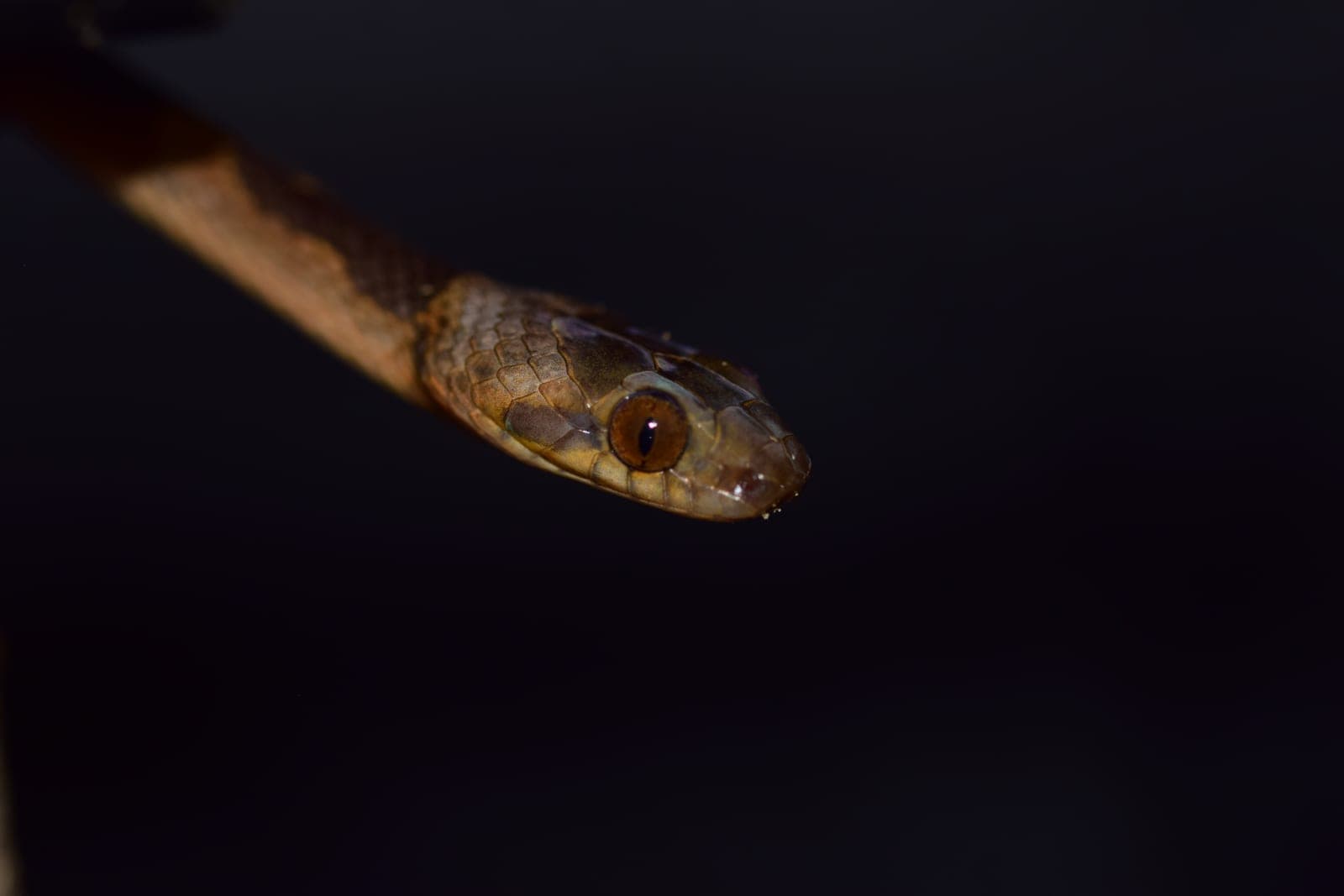
The Cat-Eyed Snake, locally called the False Mapepire, is a nocturnal arboreal colubrid named for its large, distinctively cat-like elliptical pupils, which glow bright orange-yellow in torchlight. Found on both Trinidad and Tobago, it is a specialist predator of tree frogs and their egg masses and one of very few snakes in T&T known to raid frog foam nests. Despite its local name, it is completely harmless to humans.
Description
Leptodeira annulata ashmeadi reaches approximately 60 to 90 cm with a slender build. The dorsal pattern is irregular dark brown blotches or saddles on a yellowish, cream, or pale orange ground colour. This pattern superficially resembles the Mapepire Balsain and results in the snake being killed frequently by people who encounter it at night. The definitive distinguishing feature is the eye: the Cat-Eyed Snake has very large eyes with vertical elliptical pupils that reflect dramatically in torchlight, completely unlike the smaller, rounder eye of the mapepire.
Ecology
The Cat-Eyed Snake is a specialist nocturnal hunter of tree frogs such as Trachycephalus and Phrynohyas, which it locates in low vegetation and on leaves over water. It is also one of the few snakes documented to locate and eat frog egg masses directly from the foam nests that certain hylid frogs produce over water. The rear-fanged Duvernoy's gland venom is effective against amphibian prey and causes some swelling in the hands of handlers but is not medically significant.
Conservation
The subspecies ashmeadi is the form described from Trinidad and Tobago. The broad species L. annulata ranges across Central and South America and the Caribbean, and subspecies are distinguished mainly by scale counts and colour. Found on both islands, the Cat-Eyed Snake is fully protected under the Conservation of Wildlife Act. It is most likely to be encountered on night walks along streams or in forest at the edge of ponds where tree frogs congregate to breed.
Threats
- Persecution: frequently killed due to superficial resemblance to the Mapepire Balsain
- Habitat loss and reduction of frog breeding sites