Reptile
Cascabel Dormillon (Tree Boa)
Corallus ruschenbergerii
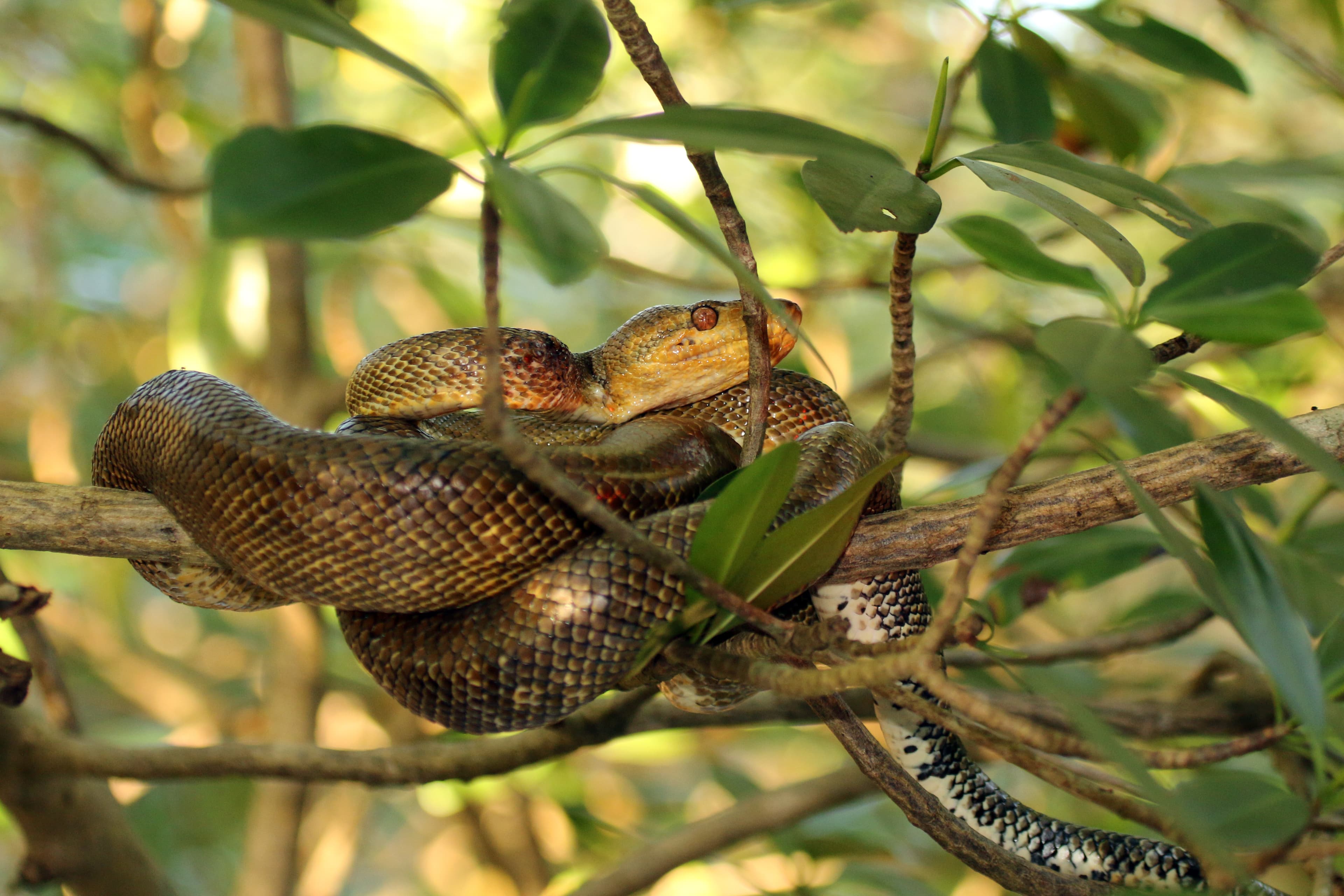
The Cascabel Dormillon, also called the Cook's Tree Boa or Dormillon, is a slender, strongly arboreal non-venomous boa found on both Trinidad and Tobago. One of the most polychromatic snakes in T&T, individuals range from black to grey, brown, green, yellow, red, and orange, plain or patterned. This striking variability makes the species both a favourite among naturalists and a source of confusion for those trying to identify snakes by colour alone.
Description
The Cascabel Dormillon is a medium-length, lightly built boa reaching 1.5 to 2 m. The head is large and triangular in proportion to the slender body, and the long, sensitive prehensile tail grips branches securely, allowing the snake to hang with the front portion of the body looped in an S-curve while waiting to strike at prey. Labial pits line the upper and lower lips, providing heat-sensing capability for locating warm-blooded prey in the dark.
Ecology
Strictly nocturnal and almost entirely arboreal, the Cascabel Dormillon hunts birds and bats in the forest canopy and upper understorey; lizards and small mammals are also taken. It is a constrictor, seizing prey with recurved teeth and coiling rapidly around it before swallowing it whole. Females give birth to 4 to 10 live young; the young are often dramatically coloured in orange or red and gradually change to their adult colouration over months.
Conservation
Despite being non-venomous, the Cascabel Dormillon will bite vigorously when handled or threatened. Bites are not medically significant but can draw blood. The snake is fully protected under the Conservation of Wildlife Act. Locally it is known as the Dormillon, from French Creole, and the name Cascabel (Spanish for rattlesnake) reflects historical confusion with venomous species.
Threats
- Persecution: killed out of fear and misidentification as venomous
- Habitat loss and forest fragmentation
- Collection for the pet trade