
Invertebrate
Caribbean Spiny Lobster
Panulilus argus
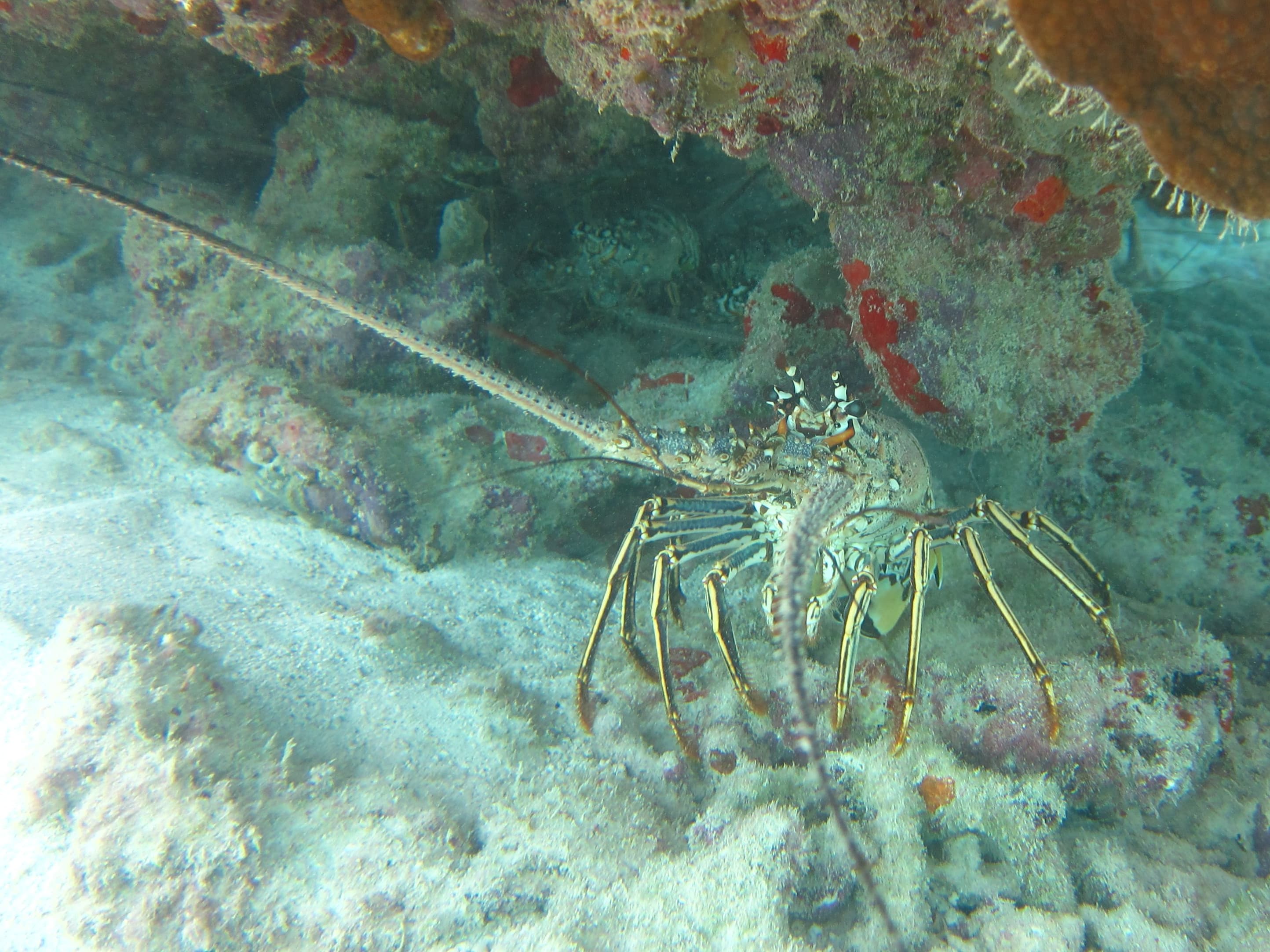
The Caribbean Spiny Lobster is also known as the Florida Spiny Lobster. They get their name from the foward - pointing spines that cover their bodies. They have long horn-like antennae over their eyes that they wave to scare off predators and smaller antennae-like "antennules" that sense movement and detects chemicals in the water. Adult Lobsters can range from tan, brown or grey with brown, orang
Description
The Caribbean Spiny Lobster is also known as the Florida Spiny Lobster. They get their name from the foward - pointing spines that cover their bodies. They have long horn-like antennae over their eyes that they wave to scare off predators and smaller antennae-like "antennules" that sense movement and detects chemicals in the water. Adult Lobsters can range from tan, brown or grey with brown, orange-yellow, red, black or green spots. Their legs are stripped with blue and orange-yellow and they have black -brown stripes on their tail fans. Juveniles are purplish in colour. They have large eyes at the front of the head and lack claws. They have a cylindrical carapace with two antennae which are covered in short spines which are longer than the body. Adults live in cracks and crevices or coral reefs, sponge flats and other hard bottom areas. Mating is seasonal and one male can mate with multiple females, while females only mate with one male. A male will seek out a female and uses his front legs to gently coax her out of her shelter. The lobsters will then lie belly to belly and the male releases a spermatophore (sperm sac) onto the female's tail or underside of her belly. When the female eggs are ready to be fertilized she scratches the sperm sac to release the sperms as she releases her eggs. Depending on her size she can lay 230 000 - 2.5 million eggs. Fertilized eggs are bright orange and darken in colour as the embryo develops. The female carries her eggs beneath her tail and after 3 weeks they will hatch. Males do not exhibit any parental care and from larvae stages the young are independent. The newly hatched lobsters are called phyllosomoes and looks nothing like their parents. Larvae undergo 11 distinct stages and after 6-9 months they molt and metamorphose into juvenile lobsters. Caribbean Spiny lobsters are nocturnal.
Fun Facts
The Caribbean Spiny Lobster never stops growing. The shell is really a skeleton on the outside of the body. It does not expand and therefore the lobster must molt in order to grow bigger. Before molting, the lobster begins building a new larger skeleton inside the existing one. As it grows, it splits open the outer shell and the new exoskeleton hardens. Lobsters can swim backwards. When they are alarmed they scoot away in reverse rapidly by curling and uncurling their powerful tails.