Reptile
Burrowing Snake
Typhlops brongersmianus
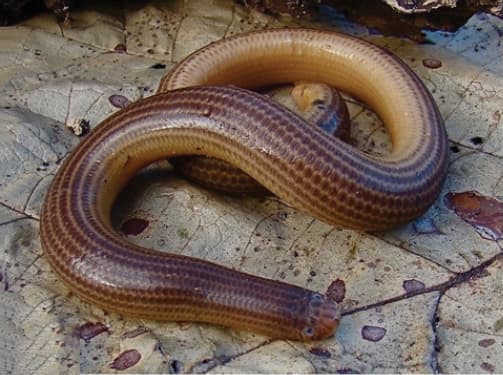
The Burrowing Snake is a small, blind, cylindrical snake of the family Typhlopidae found in Trinidad. Like the related Ground Puppy, it spends virtually its entire life underground, feeding on ant and termite larvae. Typhlopid blind snakes represent one of the most ancient surviving snake lineages, and their fossorial lifestyle is so complete that most people who share a garden with them will never know it.
Description
Typhlops brongersmianus is a small snake reaching approximately 20 to 35 cm. The body is smooth, shiny, and cylindrical, with a pinkish-brown or purplish coloration that closely resembles a large earthworm in both appearance and diameter. The head is blunt and barely distinguishable from the neck; the eyes are vestigial, visible only as dark spots under the head scales; and the tail ends in a short, hardened spine used for purchase when burrowing through soil. The scales are uniform, smooth, and overlapping in an unbroken cylindrical sheath.
Ecology
Typhlopid blind snakes are chemosensory specialists. They locate ant and termite colonies by following pheromone gradients through the soil, enter the nest, and feed on the eggs, larvae, and pupae. Unlike leptotyphlopids (thread snakes), which are thought to lick up small prey items, typhlopids have a more functional lower jaw and can swallow small prey directly. They are believed to be immune to, or at least resistant to, the biting and chemical defences of the ant and termite species they consume.
Conservation
Because they are entirely fossorial and surface only rarely, usually after heavy rain, Typhlops brongersmianus is far more common in suitable habitat than records suggest. Encounters at the surface are almost always accidental, and the snake is typically found by turning over logs, in compost, or during garden digging. It is completely harmless to humans, too small to bite effectively even if it tried, and is fully protected under the Conservation of Wildlife Act.
Threats
- Habitat disturbance and soil degradation
- Compaction of soil by livestock and agriculture reducing burrowing habitat
- Decline of ant and termite colonies in degraded habitats