
Invertebrate
Blue Land Crab
Cardisoma guanhumi
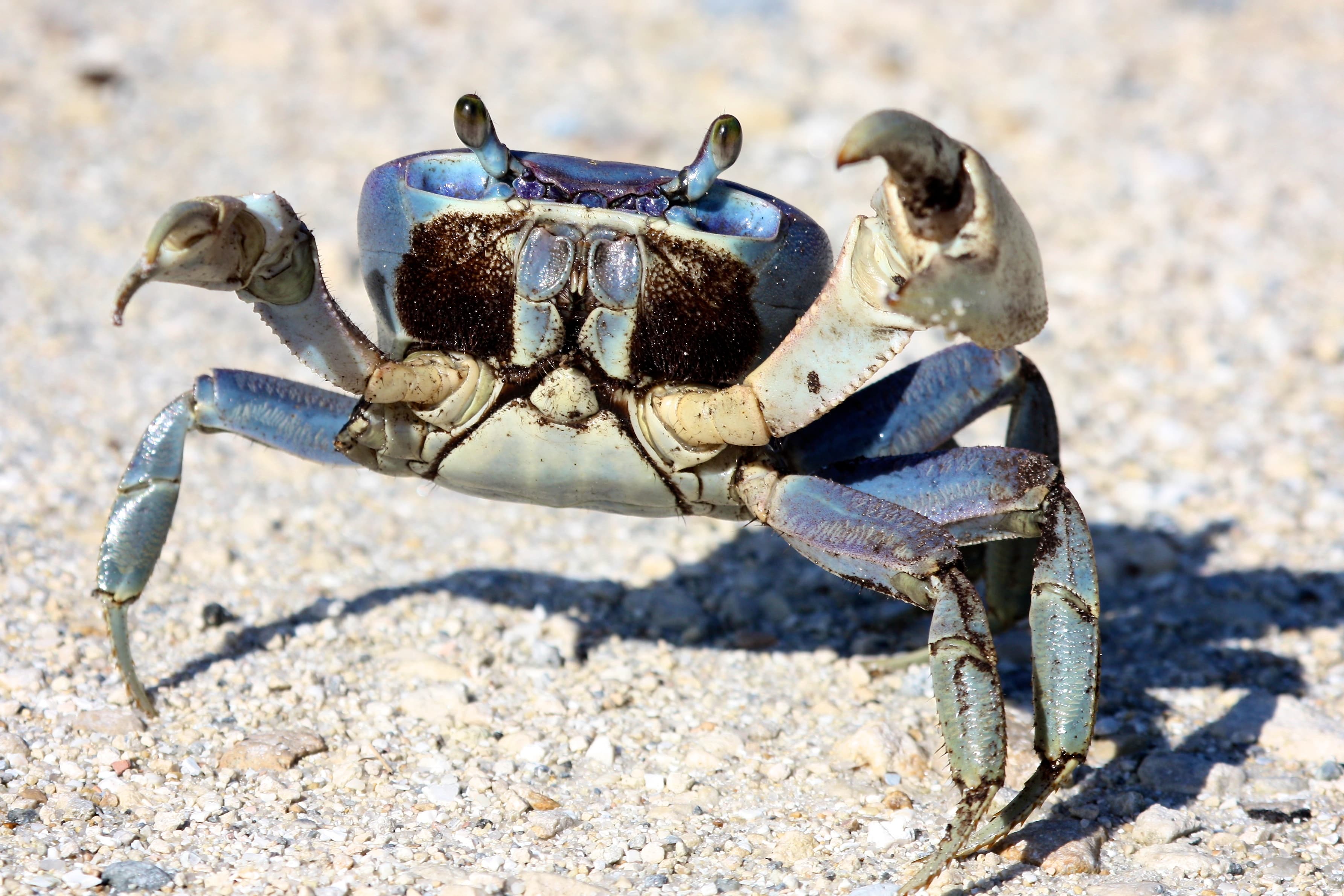
The Blue Land Crab or Giant Land Crab is usually Blue to violet in colour, ovigerous females (females with eggs) differ in colour and are mostly light grey or white. Their bodies are protected by a smooth carapace consisting of a Cephalothorax (head and thorax fused together) and abdomen. Connected to the Cephalothorax are 5 pairs of legs, the first pair bearing claws or pincers are attached to th
Description
The Blue Land Crab or Giant Land Crab is usually Blue to violet in colour, ovigerous females (females with eggs) differ in colour and are mostly light grey or white. Their bodies are protected by a smooth carapace consisting of a Cephalothorax (head and thorax fused together) and abdomen. Connected to the Cephalothorax are 5 pairs of legs, the first pair bearing claws or pincers are attached to the sides, to the front of the body. The remaining 8 legs are long and slender that end in sharp claws and are uses for walking, running and even climbing. As with many Crab species, males possess dimorphic claws, one claw can grow longer and eventually become larger than the carapace itself. The larger claw (pincer) can grow up to 15 cm in length and is used for gripping, fighting, catching prey and tearing food to eat. They also have two eyes on short movable stalks that stick out of their heads. At the rare, their tiny abdomen is bent under the cephalothorax. The abdomen of the female is wider, flatter, broad and round, in males it is narrow and pointed. Blue Land Crabs reach sexual maturity in approximately four years. The reproductive cycle is heavily dependent on weather and lunar cycles. At the beginning of rainy season females begin to search for a mate. After mating she lays her eggs but carries the egg mass beneath her body in a pouch. The eggs hatch in approximately 2 weeks but the larvae (zoea) must be released into saltwater to survive. Females migrate to the ocean and release eggs into shallow water. Females can produce an average of 52 000 offspring each time, but very few survive. Once the eggs hatch, the tiny larvae are carried out to sea. The development stage (from larvae to small crab) takes about 1 month. Juveniles crabs are usually brownish-orange to purple in colour with orange legs. They live in burrows that must be deep enough to reach the water table and maintain a pool of water year round, water could be fresh, brackish or saltwater and can be as deep as 6 ft. Blue Land Crabs are nocturnal and semi- arboreal.
Fun Facts
Crabs belong to a group of invertebrates called arthropods, all have armoured plated bodies with jointed legs, which makes them more flexible. Their shell does not grow in size, they have to shed (molt) several times as they grow. Blue Crabs can molt 60 times before reaching maximum size. Most Crabs walk sideways due to the position of their legs on the side of their body. This enables them to run very fast at speeds of 1.8 - 2 mph.