Reptile
Black-Headed Snake
Tantilla melanocephala
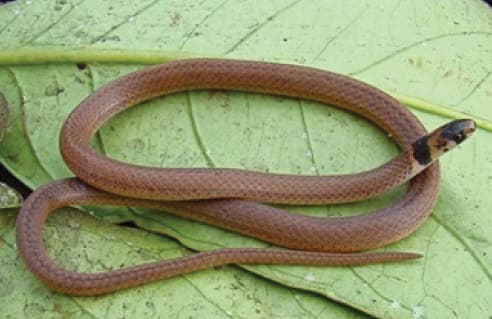
The Black-Headed Snake is one of the smallest snakes in T&T and is unmistakable at close range: its glossy jet-black head contrasts sharply with a pale reddish-brown or tan body. Found on both Trinidad and Tobago, this fossorial colubrid lives under logs and leaf litter, feeding on centipedes and invertebrates with the aid of rear-fanged venom. Completely harmless to humans and rarely encountered, it is fully protected by law.
Description
Tantilla melanocephala is a small, slender snake, typically 20 to 35 cm in length and correspondingly thin. The jet-black head and first few neck scales contrast with the pale reddish-brown, tan, or orange-brown body; a pale or whitish collar is often visible immediately behind the black cap. The tail is short. The eyes are small. In overall appearance it is quite unlike any dangerous species in T&T: its small size, distinctive colouration, and slow, deliberate movement make it easily recognisable once one is familiar with it.
Ecology
The Black-Headed Snake is a specialist predator of centipedes and large insect larvae, for which its rear-fanged Duvernoy's gland venom provides immobilising secretions. Centipedes in particular, which can be aggressive and venomous themselves, require chemical assistance to subdue. The snake's tiny mouth restricts it to prey that fits within those physical constraints. It is fossorial, found under logs, rocks, and within moist leaf litter in forest and gardens on both islands.
Conservation
The genus Tantilla spans the Americas from the United States to Argentina, and T. melanocephala is one of the most widespread species. In T&T it occurs on both islands and is probably more common than records indicate, as its cryptic, underground lifestyle means that most encounters are accidental. It is fully protected under the Conservation of Wildlife Act. In gardens it is entirely beneficial, reducing centipede populations that would otherwise be a nuisance.
Threats
- Habitat disturbance and soil compaction