
Reptile
Black Cribo (Mussurana)
Clelia clelia clelia
The Black Cribo is one of the most ecologically important snakes in Trinidad, a large, powerful colubrid that preys extensively on other snakes, including the venomous Mapepire Balsain and the Mapepire Zanana. Non-venomous to humans, it is immune to the hemotoxic venoms of pit vipers, making it a natural biological control of the island's most feared species. It is found only on Trinidad.
Description
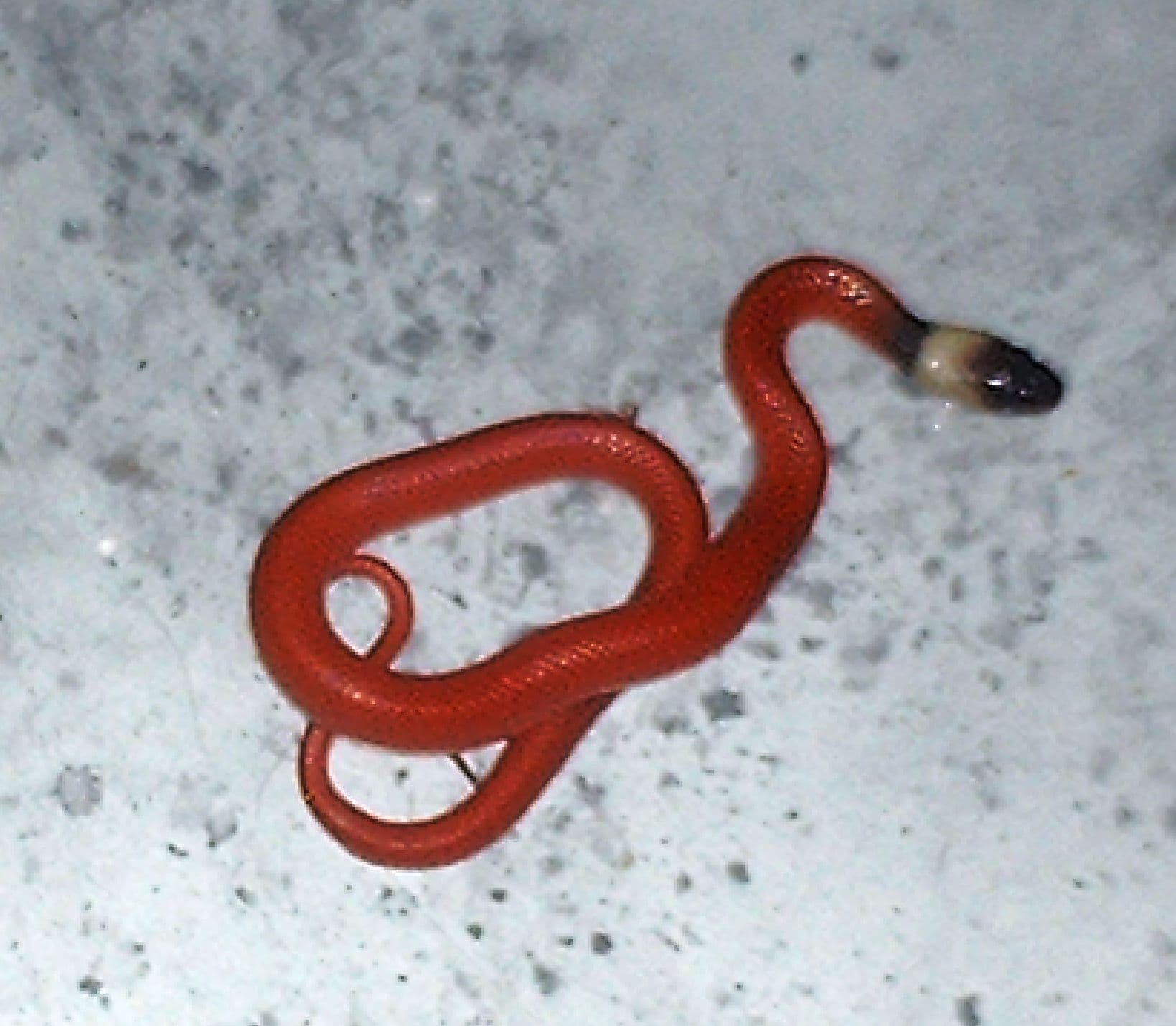
Adult Black Cribos are large snakes, reaching 1.5 to 2.5 m, with a glossy blue-black dorsum and an off-white or pale belly. Juveniles are dramatically different: the body is vivid red with black-and-white bands on the head and neck, and they could easily be mistaken for a different species. This juvenile colouration changes gradually over 3 to 4 years to the adult blue-black form.
Ecology
The Black Cribo is a dedicated ophiophage (snake-eater), actively pursuing and overpowering venomous vipers in addition to other snakes, lizards, and small mammals. It is known to be immune to the hemotoxic venom of Bothrops (mapepires), though it is not immune to the neurotoxic venom of coral snakes. It kills prey by constriction and is a rear-fanged species, with enlarged grooved teeth at the back of the upper jaw used to help subdue prey. Primarily terrestrial and nocturnal, it is most often encountered on the forest floor.
Conservation
The Black Cribo is fully protected under the Conservation of Wildlife Act and plays a significant but underappreciated role in controlling population densities of venomous snakes. Where it is common, the incidence of mapepire encounters may be reduced. It is not found on Tobago.
Why It Matters
The Black Cribo is a natural predator of Trinidad's two venomous pit vipers. A large adult cribo is one of very few animals on the island willing and able to pursue, overpower, and eat a fully grown Mapepire Balsain. This is not a trivial ecological fact: it is the mechanism by which mapepire populations are kept in check in intact forest. Where cribos are common, vipers are less so. The relationship is ancient and precise. People who kill every large dark snake they encounter are statistically killing far more cribos than mapepires, and in doing so they remove the predator that controls the species they fear most. The cribo's juvenile colouration is striking enough to be recognised and documented; its adult colouration is a glossy blue-black that is often confused with the mapepire balsain at a distance. Correct identification matters practically, not just scientifically.
Threats
- Persecution and killing, often due to large size and dark colouration
- Habitat loss and forest fragmentation
- Decline of prey base (smaller snakes)