
Reptile
Beh-Belle Chemin
Liophis melanotus nesos
The Beh-Belle Chemin is a small, slender, diurnal colubrid found on both Trinidad and Tobago. Its local French Creole name translates loosely as "stays on the road" or "road crawler," reflecting its habit of being found on paths and open ground. One of the more commonly encountered small snakes on both islands, it is completely harmless and feeds on small lizards and frogs.
Description
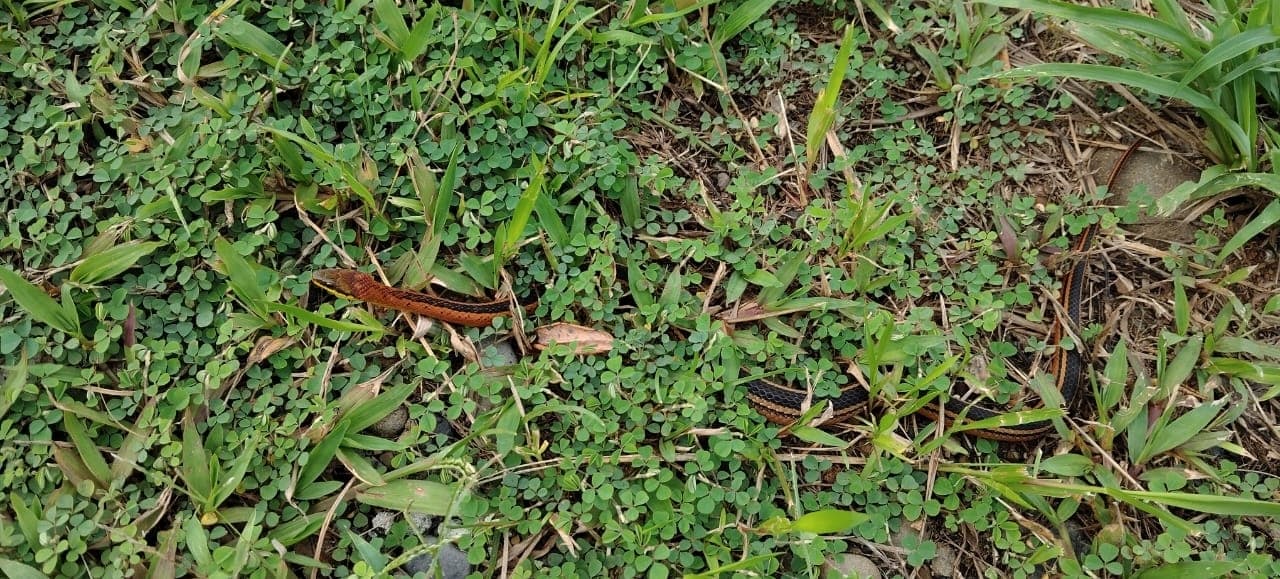
Liophis melanotus nesos is a small to medium colubrid typically reaching 40 to 70 cm. The dorsal colour is dark brown to olive or blackish, often with a faint pattern of spots or flecking; the belly is pale yellowish, cream, or with a reddish or orange flush, particularly toward the tail. The head is small and rounded. The subspecies nesos is specific to Trinidad and Tobago, making it an endemic subspecies of the two-island republic.
Ecology
Active during the day, the Beh-Belle Chemin forages actively on the forest floor, in secondary growth, gardens, and along the margins of agricultural land, where it hunts small lizards and frogs. It is quick and alert, and when disturbed it moves rapidly through vegetation. Unlike many small snakes that rely on camouflage or burrowing, it is relatively conspicuous, which likely explains its reputation for being commonly seen on tracks and paths.
Conservation
As a member of the genus Liophis (treated in some modern checklists within the broader genus Erythrolamprus), the Beh-Belle Chemin is a rear-fanged colubrid, but its venom is specialised for subduing small ectothermic prey and presents no medical risk to humans. It is fully protected under the Conservation of Wildlife Act and occurs across a wide range of habitats from sea level to forested hills on both islands.
Threats
- Persecution: frequently killed by people who assume any unfamiliar snake is dangerous
- Habitat loss and agricultural conversion
- Road kills due to ground-level foraging behaviour