Reptile
Anaconda (Huilla)
Eunectes murinus gigas
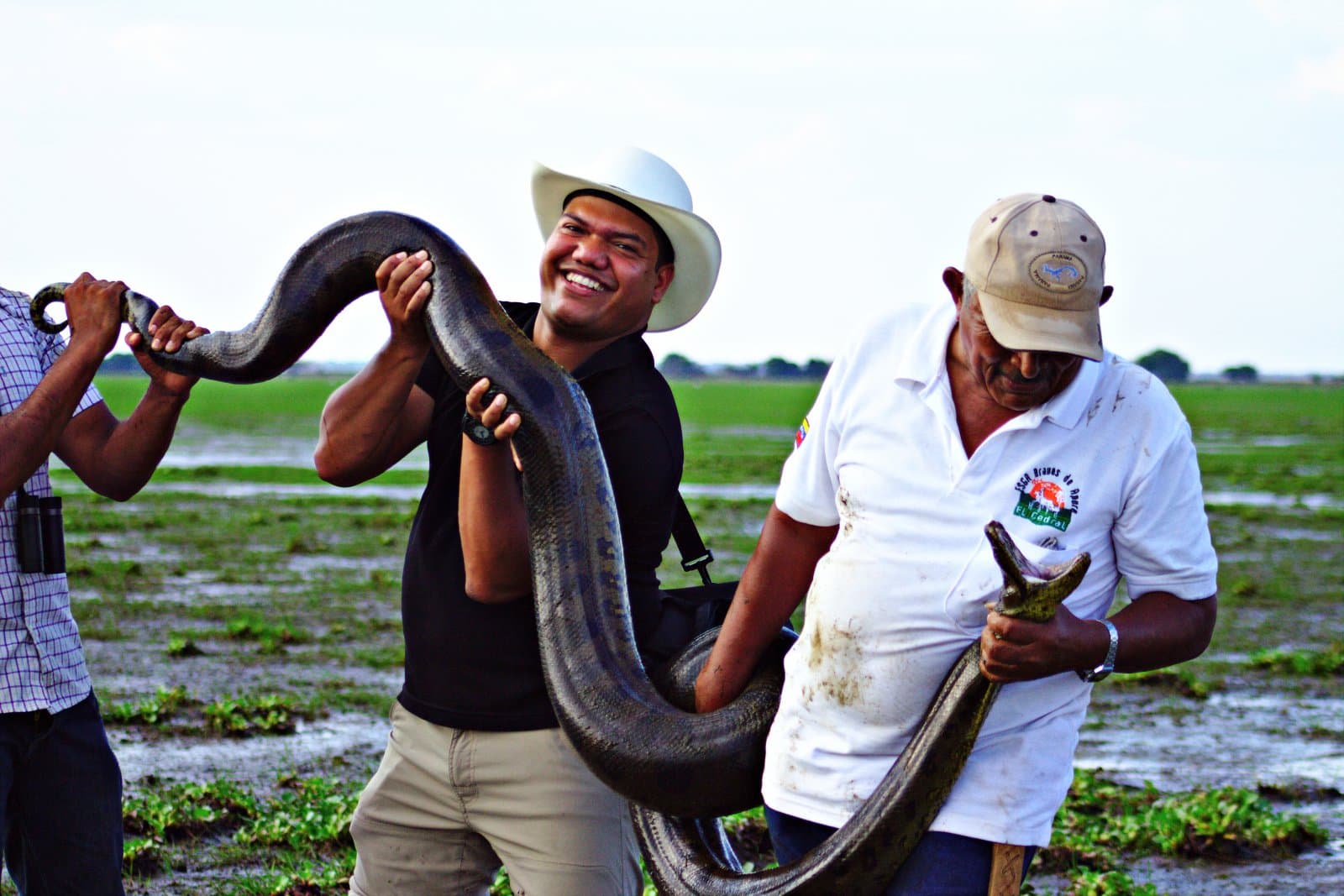
The Anaconda is Trinidad's largest snake and one of the heaviest snakes in the world, found in the rivers, swamps, and lagoons of the island's eastern and southern lowlands. Deeply embedded in local folklore, it is known locally as the huilla or huille, and has inspired more legend, exaggeration, and fear than perhaps any other animal in the country. Despite its formidable size and genuine capacity to overpower large prey, the anaconda is not venomous and plays a critical ecological role as an apex aquatic predator in Trinidad's freshwater ecosystems.
Description
The anaconda is a massive, muscular snake with a body that is thick and heavy relative to its length, perfectly adapted for life in water. Ground colour is light to dark grey-green, overlaid with large, irregular darker spots and blotches along the back; two dark stripes run through the occiput and temporal area of the head, separated by a dirty-orange stripe that helps identify the subspecies found in Trinidad (Eunectes murinus gigas). The eyes and nostrils are positioned near the top of the head, allowing the snake to breathe and see while almost entirely submerged. Females are substantially larger than males; the largest reliably measured specimens from Trinidad are in the range of 5–6 m, though folklore claims of 10 m and beyond are unverified.
Ecology
Almost entirely aquatic, the anaconda is most at home in the rivers, oxbow lakes, swamps, and canal systems of the Nariva Swamp and the low-lying south and southwest of Trinidad. It hunts by ambush at the water's edge, seizing prey with a rapid strike and drowning or constricting it before swallowing it whole. The young take fish, aquatic turtles (Kinosternon), and frogs; adults take any prey they can subdue, including capybara, caiman (Caiman crocodilus), deer, domesticated animals, and large birds. Mating occurs in December and January, with as many as twelve males attending a receptive female in what is called a "breeding ball"; females give birth to live young, between 20 and 40 per litter, in July and August.
Natural History
The maximum size of the anaconda has been the subject of sustained mythology and misinformation. A long-standing world record of 11.4 m (37.4 ft) claimed for a Venezuelan specimen has been reassessed and is now considered to be under 8 m. The New York Zoological Society has maintained an unclaimed $50,000 reward for any live specimen exceeding 30 feet. In Trinidad, the famous claim of a 37-foot specimen from the Guaico-Tamana area was shown by Hans Boos to have been a misidentified boa constrictor. The true maximum in Trinidad is likely in the range of 5–6 m for large females, still making it one of the most impressive animals on the island.
Conservation
The anaconda was featured on the 30-cent stamp in the 1983 national snake postage series. It is protected in Trinidad by law, though its remote wetland habitats and the difficulty of monitoring populations mean that its status is not well quantified. Hunting of anacondas for their skin, meat, and use in traditional medicine has historically occurred and may continue at low levels.
Why It Matters
The anaconda is Trinidad's apex aquatic predator. In the Nariva Swamp and the river systems of the south and east, it regulates populations of caiman, large rodents, and waterfowl, performing in freshwater habitats the same top-predator function that the jaguar performs in forests. Wetland food webs in Trinidad are shaped by the presence or absence of this animal. Remove it, and the dynamics of those ecosystems shift in ways that are difficult to predict and harder to reverse. No animal in Trinidad has generated more myth per kilogram than the anaconda. Stories of 40-foot specimens swallowing horses, attacking bathers, and lurking in cane fields have circulated for centuries and have made it a target of reflexive killing. The historical record is clear: reliably documented attacks on humans by anacondas are extraordinarily rare, and no fatality from anaconda attack has been verified in Trinidad. The fear that this snake carries is an artifact of folklore, not of the animal's actual behaviour toward people. The Nariva Swamp, Trinidad's most important freshwater wetland and a Ramsar site, is the anaconda's primary habitat in Trinidad. Protecting one means protecting the other. The swamp is simultaneously the island's largest freshwater reservoir, a manatee sanctuary, a nesting site for spectacled caiman, and the home of Trinidad's only population of anacondas. An ecological argument for protecting the Nariva Swamp could be built entirely around any one of those facts; that all of them are true simultaneously makes the case overwhelming.
Threats
- Killing on sight from fear and misidentification
- Hunting for skin, meat, and use in folk medicine
- Wetland drainage and habitat degradation, especially in Nariva Swamp and southern swamplands
- Water pollution reducing prey availability
- Road kills near wetland margins