Bird
Trinidad Piping-Guan (Pawi)
Pipile pipile
Photo: William Stephens · Trinidad and Tobago (CC BY 4.0)
The Trinidad Piping-Guan, known locally as the Pawi, is one of the rarest birds on Earth, a large, striking forest bird found nowhere else in the world but Trinidad. Restricted to the dense primary forests of the Northern Range and Matura, this critically endangered species teeters on the edge of extinction, with fewer than a few hundred individuals believed to survive. A powerful symbol of Trinidad's biodiversity heritage, the Pawi's fate depends entirely on the protection of its forest home and an end to illegal hunting.
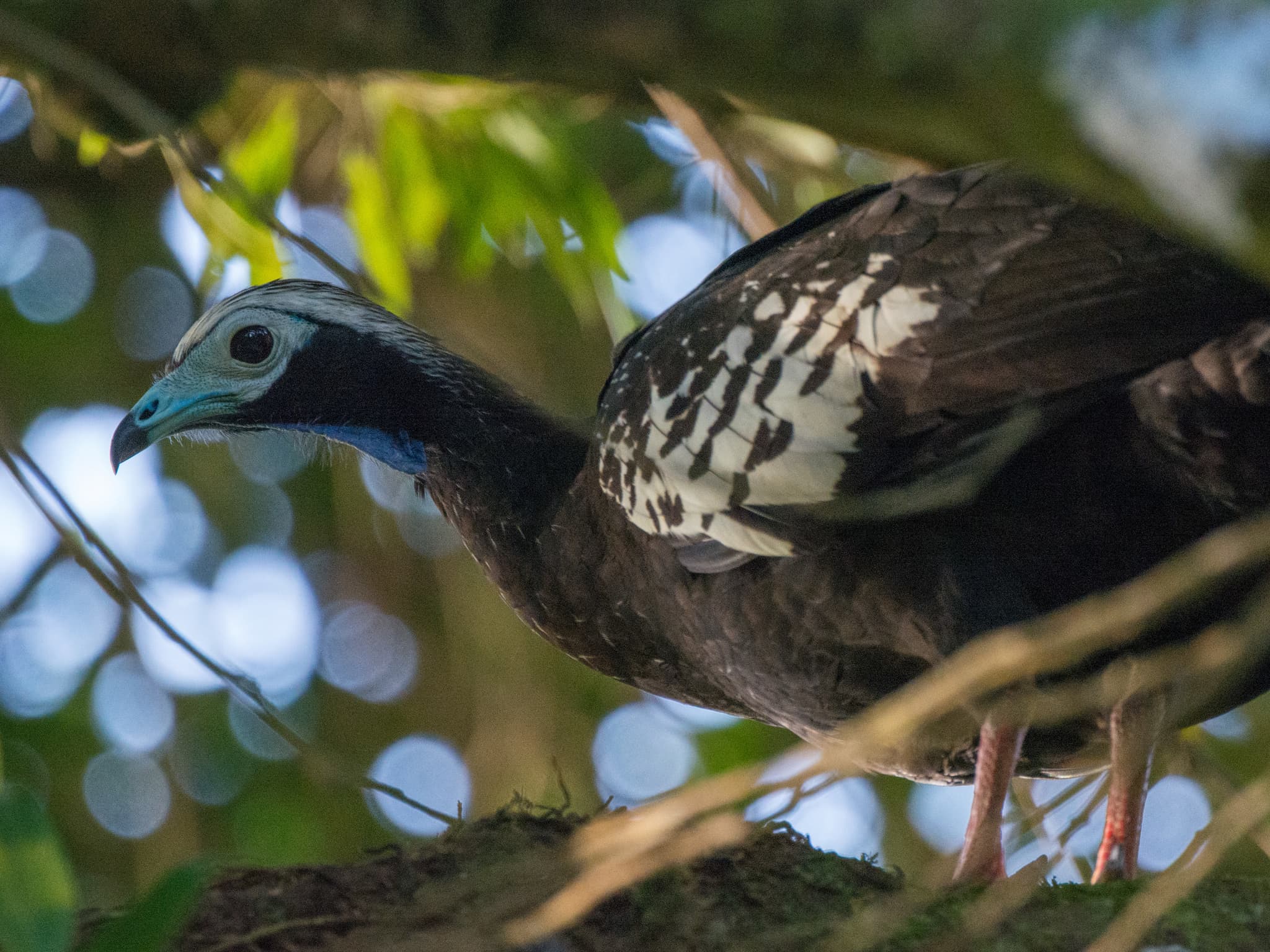
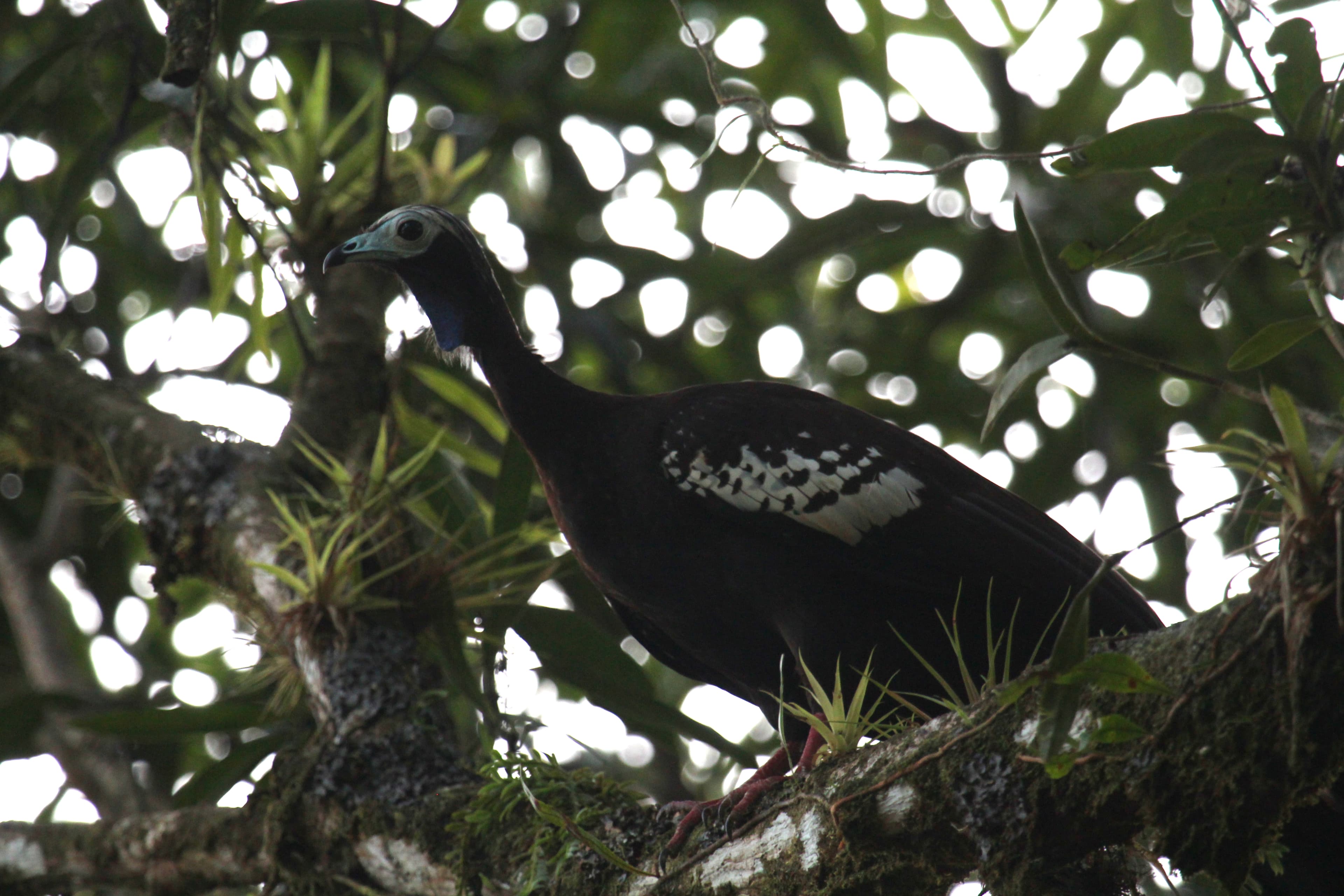
The Pawi is a large, dark-plumaged bird belonging to the ancient family Cracidae (the guans, curassows, and chachalacas), a group with origins stretching back tens of millions of years in the Neotropics. Adults measure approximately 65–75 cm in length and weigh around 1.4 kg. The plumage is predominantly glossy black-blue with a conspicuous white wing patch visible in flight. The bare facial skin and wattles are vivid blue-red, the bill has a pale blue base, and the legs are red, a combination that makes the Pawi unmistakable to those fortunate enough to encounter it in the forest canopy.
Ecologically, the Pawi plays a vital role as a seed disperser in Trinidad's mature tropical forests. Its diet consists principally of wild figs, palm fruits, berries, and seeds, which it forages for in the upper forest canopy. By consuming and depositing large seeds across the forest, the Pawi contributes to forest regeneration in ways that few other species can replicate. It is primarily diurnal and arboreal, rarely descending to the ground, and is most often detected by its high-pitched, piping calls that carry through the forest understorey at dawn.
The species breeds between November and February. Nests are platform structures built in tall forest trees, typically producing a clutch of two to three eggs. Juveniles remain with parents for an extended period, and the low reproductive rate, combined with the species' already tiny population, makes recovery from hunting pressure exceptionally slow. Surveys in the Northern Range and Matura Forest have documented the species at key sites including the Arima Valley, the upper Oropouche watershed, and forest areas near Matura village on the northeast coast.
The Pawi Study Group, founded in 1990, has been the cornerstone of conservation efforts for this species in Trinidad, conducting population surveys, community education, and advocacy for stronger forest protection. Despite legal protections under the Conservation of Wildlife Act and its listing on CITES Appendix I, illegal hunting remains the single greatest immediate threat to the species' survival. The Pawi's restricted range, entirely within Trinidad, means that any local extinction would be global extinction.
Why This Matters
The Pawi's value to Trinidad's forests cannot be overstated. As one of the island's primary large-frugivore seed dispersers, it ingests and deposits the seeds of wild figs, palms, and other canopy trees across wide swaths of forest, enabling forest regeneration in ways no other species on the island can fully replicate. A forest without its seed dispersers is a forest that cannot renew itself; the Pawi is one of the few animals large enough to move the biggest seeds across the landscape.
There is also a fact that carries a particular weight: because the Pawi exists only in Trinidad and nowhere else on Earth, any local extinction is a global extinction. This is not an abstract concern. With an estimated population of 70 to 200 individuals, the species is already perilously close to the threshold from which recovery becomes mathematically unlikely. The Northern Range forests that shelter the remaining population are the same forests that supply water to hundreds of thousands of Trinidadians. Protecting one means protecting the other.
Trinidad is one of the most biodiverse nations on Earth relative to its size, and the Pawi is arguably its most singular treasure: a bird that exists nowhere else, whose dawn call still rings through forests that have, so far, been kept intact. The community around Grande Riviere has shown that a living Pawi is worth far more than a dead one, through ecotourism, stewardship, and pride. That model can spread. The question is whether enough forest survives long enough for it to do so.
Threats to Survival
- Illegal hunting
- Habitat loss and deforestation
- Agricultural encroachment into forest
- Small population size and inbreeding risk
- Restricted range
- Road kills near forest edges
Seen a Trinidad Piping-Guan (Pawi)?
Sighting records help us track population status and distribution. If you observe this species, please report the location, date, time, and any photos to WEPTT.
Report a Sighting