Mammal
Trinidad Howler Monkey
Alouatta seniculus insulanus
Photo: Adam (Lynn & Kitch) (CC BY-SA 2.0)
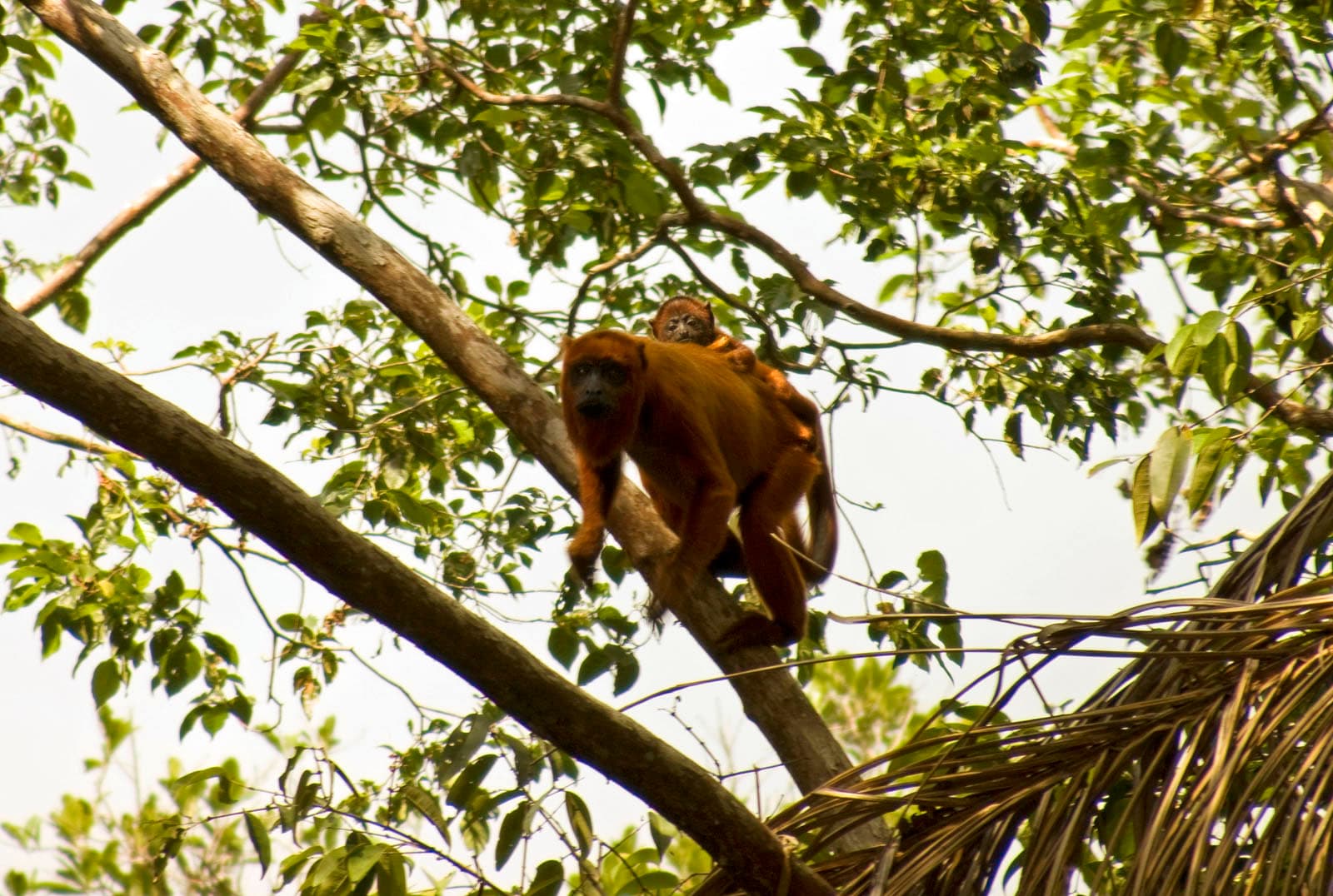
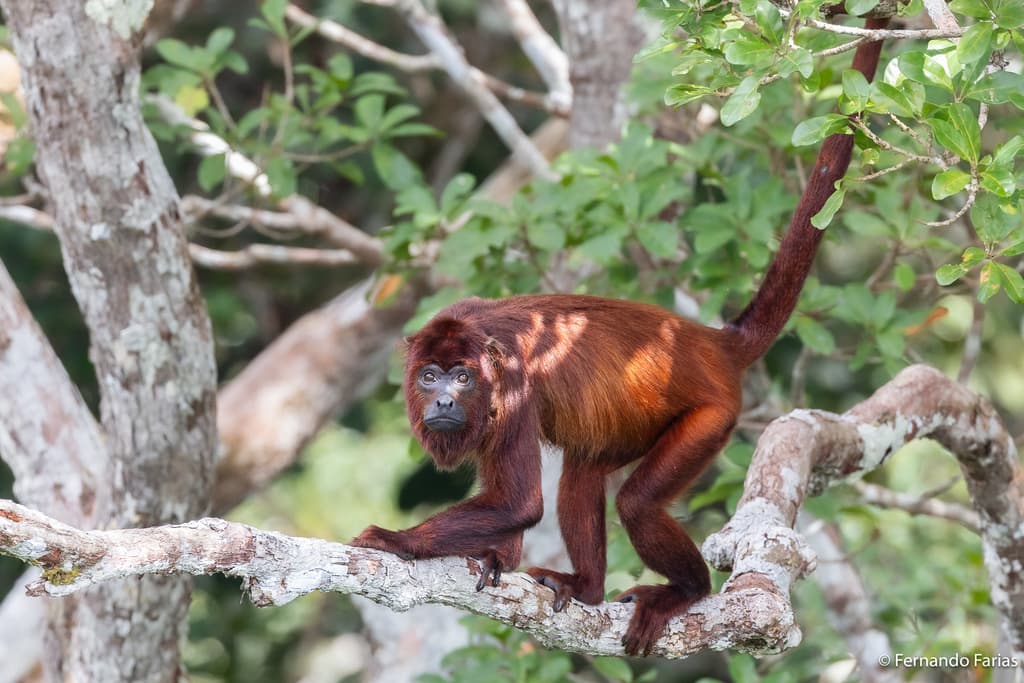
The Trinidad Howler Monkey is the island's largest primate and the author of one of its most distinctive sounds, a deep, resonant roar that carries up to five kilometres through the forest at dawn. An endemic island subspecies, the howler is both a seed disperser and a living indicator of forest health; its presence reliably signals intact, undisturbed woodland. Today it faces growing pressure from habitat loss, forest fragmentation, and an underappreciated threat: electrocution on power lines.
The Trinidad Howler is a large, robustly built monkey with reddish-brown to dark brown fur. Adult males weigh 7–9 kg and are noticeably larger than females (4–6 kg). The species is immediately recognised by its extraordinarily loud vocalisation, produced by a greatly enlarged hyoid bone in the throat that acts as a resonating chamber, amplifying the call to a deep, far-carrying roar. Howling typically occurs in chorus at dawn and in response to disturbance, serving to advertise territorial boundaries and group location. The sound is one of the defining soundscapes of Trinidad's Northern Range forests.
Howlers are primarily folivorous, with leaves forming the bulk of their diet and supplemented by fruit, flowers, and seeds. They live in cohesive social groups of typically 5–10 individuals with one or two adult males. Despite a large body and slow metabolism suited to a leaf-heavy diet, howlers are important seed dispersers, consuming and depositing a wide range of fruits and seeds as they range through the forest canopy. In Trinidad, they are found in forests across the island, most reliably in the Northern Range, but also in Central Range forests, mangroves, and lowland woodland. Their presence is widely used as an indicator of forest quality and continuity.
The Trinidad subspecies (insulanus) is assessed as Vulnerable, reflecting the combination of ongoing habitat loss, forest fragmentation that isolates populations and reduces genetic connectivity, direct hunting, and the increasingly documented threat of electrocution on uninsulated power lines. In T&T, howler monkeys are frequently killed or severely injured when attempting to cross between tree canopies via overhead power lines, with electrocutions reported regularly from communities adjacent to forest edges. Organisations such as the Wildlife Adoption and Orphan Care Organisation (WAO) and the Emperor Valley Zoo operate rescue and rehabilitation programmes for injured animals. The species is fully protected under the Conservation of Wildlife Act (COWA) and is not a game species.
Why This Matters
Before dawn on any morning in Trinidad's Northern Range, the howler monkey announces its presence with a sound that carries for up to five kilometres through the forest: a deep, resonant roar that is, for many people, the defining acoustic experience of Trinidad's wildlands. That call is not just spectacle. It is communication between groups, a declaration of territory and presence that organises the forest's primate community across wide distances. The morning chorus of howler monkeys is a signal that the forest is intact, occupied, and functioning.
Howlers are among the most important seed dispersers for the large-seeded rainforest trees of Trinidad. Leaves form the bulk of their diet, but they also consume significant quantities of fruit, and the seeds they deposit as they range through the canopy are a primary mechanism of forest regeneration for some of the forest's largest and most structurally important trees. Their presence in a patch of forest is one of the most reliable indicators ecologists use to assess forest quality and continuity. When howlers disappear from an area, it means something has gone badly wrong.
The Trinidad Howler Monkey is heard more often than it is seen, and that invisibility has perhaps allowed the scale of the threats against it to be underestimated. Electrocution on uninsulated power lines, poaching for the pet trade, and habitat fragmentation are all documented, ongoing causes of mortality. This is a species that asks only for intact forest canopy and the absence of deliberate harm. Both are achievable. The dawn roar of the howler is one of the sounds that defines what Trinidad is. Whether it still rings through the forests in fifty years is a choice being made now.
Threats to Survival
- Habitat loss and deforestation
- Forest fragmentation
- Power line electrocution
- Hunting
- Small isolated populations with reduced genetic connectivity
Seen a Trinidad Howler Monkey?
Sighting records help us track population status and distribution. If you observe this species, please report the location, date, time, and any photos to WEPTT.
Report a Sighting