
Bird
Scarlet Ibis
Eudocimus ruber
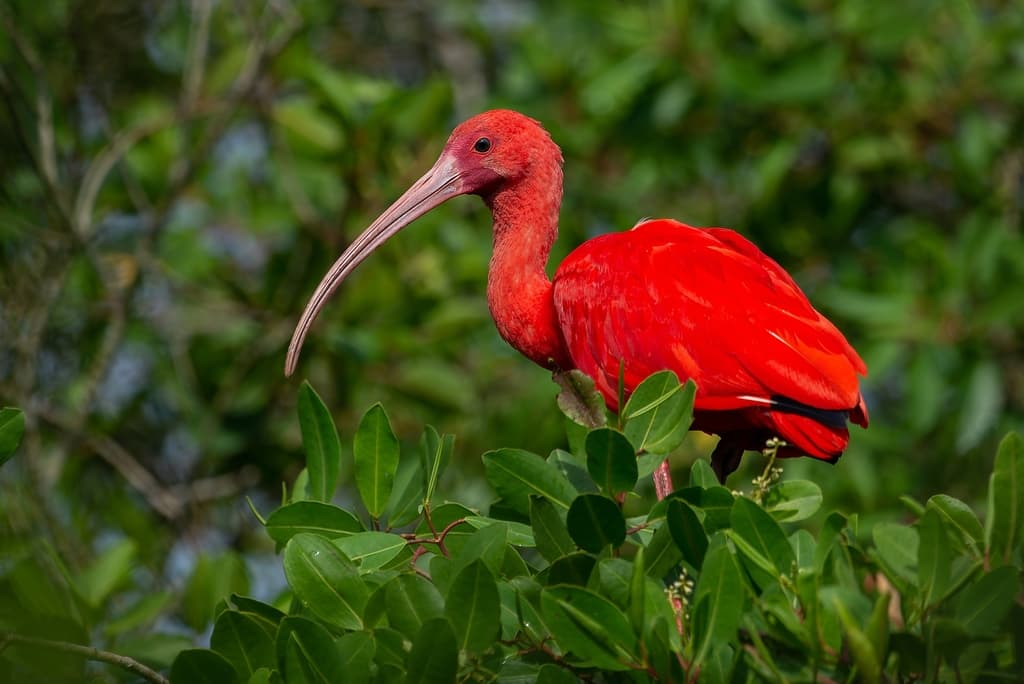
Photo: Mike's Birds · Tobago, Trinidad and Tobago (CC BY-SA 2.0)
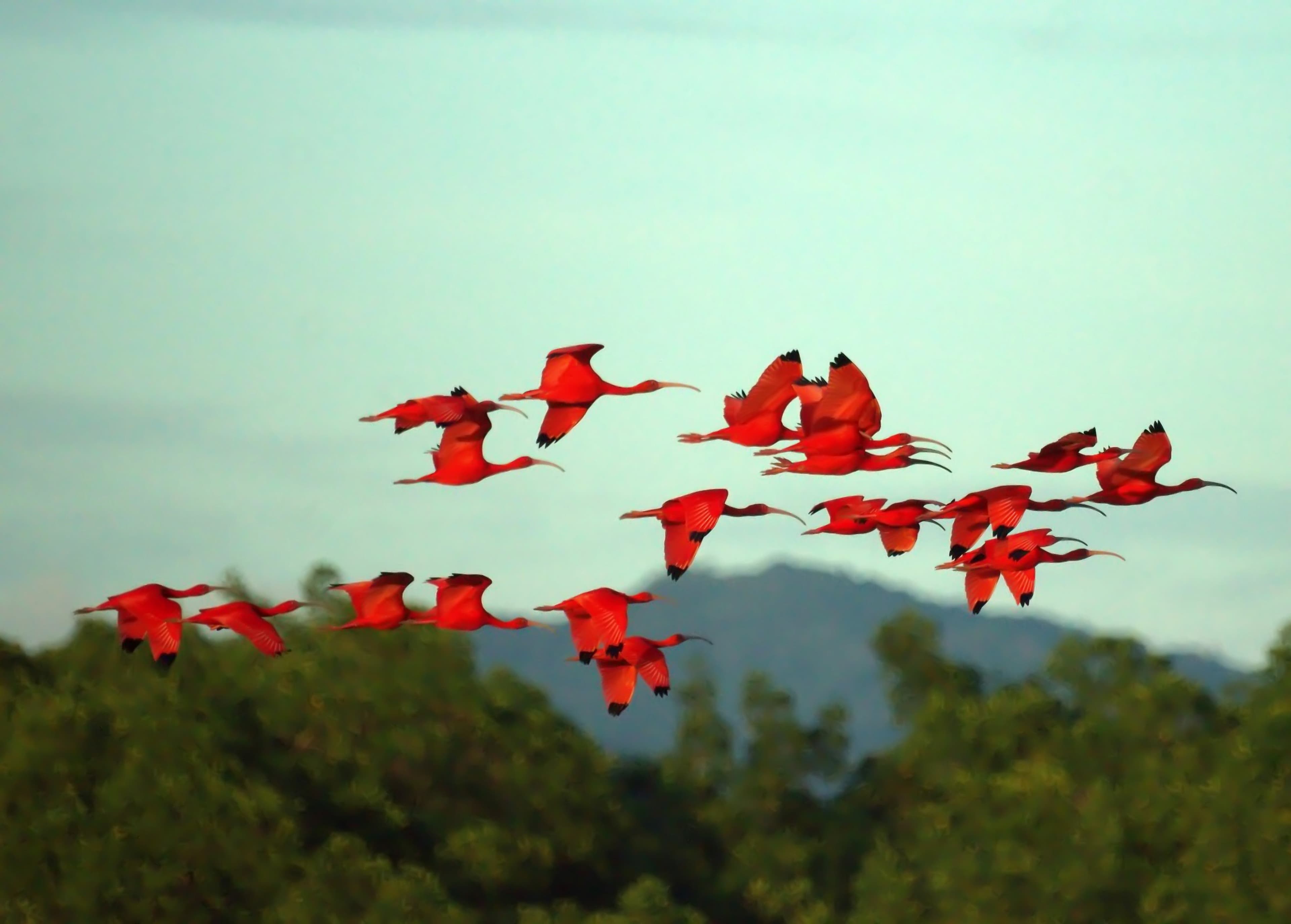
The Scarlet Ibis is one of Trinidad and Tobago's two national birds and one of the most visually striking birds in the Western Hemisphere. Its almost luminous crimson plumage, derived from the carotenoids in the crustaceans it consumes, makes it unmistakable as it wheels in vast flocks over the Caroni Swamp at dusk. Fully protected under law since 1963 and designated an Environmentally Sensitive Species in 2018, the Scarlet Ibis remains under threat from illegal poaching despite its status as a national symbol.
The Scarlet Ibis belongs to the family Threskiornithidae (the ibises and spoonbills) and is a medium-sized wading bird measuring 55–63 cm in length with a wingspan of approximately 54 cm and weighing 700–935 g. Its plumage is an intense crimson-scarlet across the entire body, contrasted by jet-black wingtips visible in flight. The long, sharply decurved bill is perfectly adapted for probing shallow mud and water in search of prey. Juveniles hatch grey-brown and transition gradually to full adult plumage over approximately two years as dietary carotenoids, most abundantly sourced from consumed crabs and shrimp, accumulate in the feathers. The species is diurnal and highly gregarious, moving and roosting in large, often spectacular flocks.
In Trinidad, the Scarlet Ibis is inseparable from the Caroni Swamp on the western coast near Port of Spain, a 5,611-hectare estuarine system of mangrove forest, brackish lagoons, and tidal mudflats draining into the Gulf of Paria. Each evening, thousands of birds return to their mangrove roosts in one of the most celebrated wildlife spectacles in the Caribbean, with up to 15,000 birds recorded in the swamp during the non-breeding season. The birds spend their days foraging on the coastal mudflats of the Gulf of Paria, using their curved bills to probe for crabs, shrimp, mollusks, insects, small fish, and frogs. This daily mass return has sustained a thriving birdwatching ecotourism industry generating over $1 million TTD annually since the 1970s.
Although the Scarlet Ibis formerly maintained large breeding colonies in the Caroni Swamp (2,500 nests were counted in June 1963), breeding activity ceased in the swamp after 1970. Adults now depart Trinidad during the breeding season, presumed to nest at colony sites in Venezuela and northern South America, returning to the Caroni outside of breeding periods. Nesting is colonial, with pairs constructing loose platform nests of sticks in mangrove trees, typically above water for protection from terrestrial predators; clutches contain 2–3 eggs with an incubation period of 19–23 days. The Pointe-à-Pierre Wildfowl Trust, founded in 1966, runs an active captive breeding programme and produced the first Scarlet Ibis born in captivity in Trinidad in 1991.
Despite its national-bird status, the Scarlet Ibis has faced persistent illegal hunting for its meat, which is traded as a black-market delicacy and cultural status symbol. Poaching incidents recorded in 2013 and 2017 involved dozens of carcasses. The 2018 ESS designation upgraded penalties to $100,000 TTD or two years imprisonment (a dramatic increase from the previous $1,000 TTD fine that provided little deterrent). The Caroni Bird Sanctuary, a 199-hectare protected area designated in 1953, remains the cornerstone of the species' protection in Trinidad. The colloquial local name "flamingo", though widely used, is scientifically inaccurate; the Scarlet Ibis is an ibis, not a flamingo.
Why This Matters
The Scarlet Ibis is one of the most beautiful birds on Earth, and it is Trinidad's national bird. But its importance is not merely symbolic. Each evening, thousands of ibis return from tidal mudflats and mangrove channels to roost in the Caroni Swamp, a spectacle that has sustained an ecotourism economy since the 1930s. The crimson birds crossing a darkening sky above the mangroves are, in a very practical sense, the foundation of the nature tourism industry in western Trinidad: tours, guides, boats, livelihoods. A living natural resource generating real income, season after season, for the communities that protect it.
Ecologically, the ibis is inseparable from the mangrove ecosystem it roosts in. The Caroni Swamp filters agricultural and industrial runoff from the Caroni River catchment before it enters the Gulf of Paria, providing water quality services that support the coastal fishery on which fishing communities depend. The mangroves act as a nursery for juvenile shrimp, snapper, mullet, and dozens of other fish species. Up to 15,000 Scarlet Ibis roosting in those trees return nutrients to the mangrove soil through their droppings, contributing to the productivity of the system that feeds them. The ibis and the swamp are in a relationship of mutual sustenance.
The Scarlet Ibis is on the coat of arms, on the one-dollar bill, in the national anthem, and in the soul of this country. That it has faced poaching for bush meat is a reminder that symbolic status is not the same as protection. The 2018 ESS designation and the dramatic increase in penalties it brought were the right response. So was the decades of patient, consistent work by Nanan's Eco-Tours in building a culture of stewardship around the swamp. Both are still needed.
Threats to Survival
- Illegal hunting for bush meat
- Habitat loss and wetland degradation
- Boat traffic disturbance at roost sites
- Pollution and water quality decline
- Cessation of local breeding since 1970
- Tourism pressure at Caroni roosting sites
Seen a Scarlet Ibis?
Sighting records help us track population status and distribution. If you observe this species, please report the location, date, time, and any photos to WEPTT.
Report a Sighting