Wildlife Sanctuary · Trinidad
Trinity Hills Game Sanctuary
Game Sanctuary · Conservation of Wildlife Act
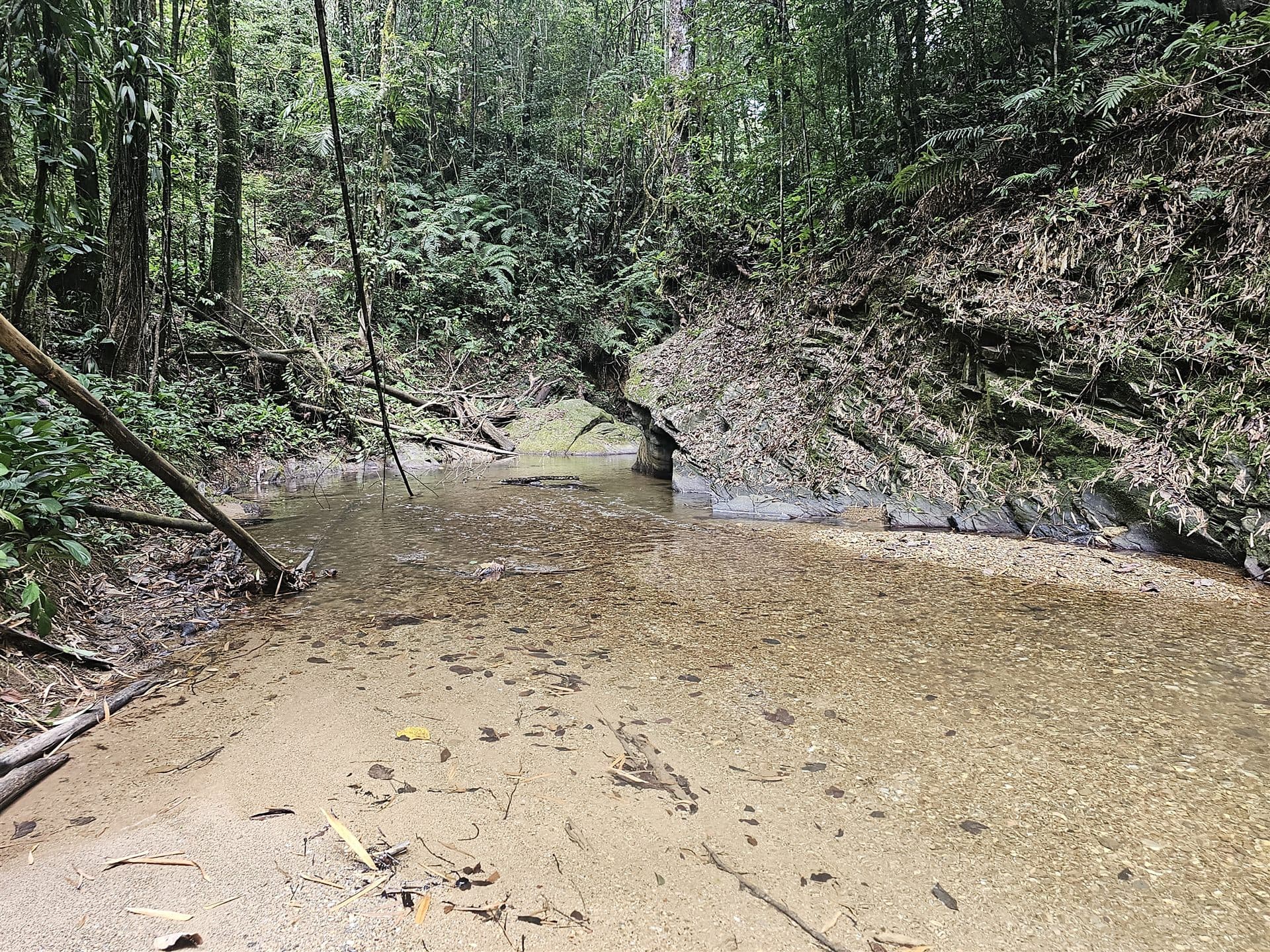
Photo: WEPTT · Trinity Hills, Trinidad (CC BY-SA 4.0)
Tucked into the rugged Southern Range of south-east Trinidad, Trinity Hills Game Sanctuary - locally known as the Three Sisters - shelters the last intact lowland virgin forest in the island's south and one of the largest undisturbed tropical forest blocks in all of Trinidad. Access is strictly restricted, and the 8,200-hectare sanctuary functions as a biological reservoir that replenishes the surrounding Victoria-Mayaro Forest Reserve and safeguards the complete mammalian fauna of the island.
Trinity Hills preserves three distinct old-growth forest faciations found nowhere else in southern Trinidad in such pristine condition: the Carapa-Mora, Carapa-Pentaclethra-Sabal, and Trichilia-Brosimum-Protium associations. This mosaic of closed-canopy lowland and foothill rainforest supports an exceptionally complete vertebrate community, including ocelots, Neotropical river otters, both white-fronted capuchin and red howler monkeys, all five legally recognised game mammals - agouti, paca, armadillo, collared peccary, and red brocket deer - and the globally endangered Trinidad piping guan (Pipile pipile), a species found nowhere else on Earth.
The sanctuary's strictly protected status, enforced by the Forestry Division under the Conservation of Wildlife Act (Chapter 67:01), has kept public access tightly restricted for decades, allowing recovering populations to persist largely free of direct human harvest. As a pilot protected area under a joint Trinidad and Tobago Government–FAO project on Improving Forest and Protected Area Management, Trinity Hills has also been recognised as a source population whose wildlife disperses outward to replenish hunted and degraded lands in the broader Victoria-Mayaro region.
Despite its protected status, Trinity Hills faces mounting pressure on multiple fronts. Oil and gas infrastructure - pipelines, power corridors, and transportation easements cut by industry operators - has progressively fragmented the sanctuary's interior. Along its boundaries, slash-and-burn cultivation and encroaching agriculture erode forest edges, while illegal hunting and reported cultivation of illicit crops deep inside the reserve undermine enforcement. The sanctuary has no buffer zone codified in law, making the transition from fully protected core to unregulated land abrupt and permeable.
Why This Matters
Trinity Hills is the last place in southern Trinidad where you can walk through lowland virgin rainforest, the kind of closed-canopy primary forest that once covered much of the island's south and now exists almost nowhere in the region. The 8,200-hectare sanctuary contains three endemic forest associations, the Carapa-Mora, Carapa-Pentaclethra-Sabal, and Trichilia-Brosimum-Protium faciations, found in their pristine form only here. This is not secondary growth that has regrown after clearing; it is old-growth forest that has never been substantially disturbed, a survivor from a time before the southern petroleum economy reshaped everything around it.
The completeness of Trinity Hills' vertebrate community is ecologically significant. This is one of the only places in Trinidad where all five legally recognised game mammals, along with both monkey species, ocelots, and otters, coexist within a single protected area. That completeness matters because intact predator-prey systems regulate themselves in ways that fragmented ones cannot. The Piping-Guan, whose entire global range is Trinidad, has been documented here as well. When a place holds the full suite of the ecosystem's ecological roles, it functions in ways that no piecemeal assemblage of surviving patches can replicate.
The recognition of Trinity Hills as a biological reservoir from which wildlife disperses into the surrounding Victoria-Mayaro landscape is an acknowledgement of something conservation planners call source-sink dynamics: the sanctuary produces animals, and those animals replenish populations in areas where hunting and habitat pressure would otherwise lead to local extinction. To allow Trinity Hills to be fragmented by oil infrastructure or encroached upon by cultivation is to remove the source that sustains everything downstream of it. This is one of Trinidad's most precious places. It should be treated accordingly.
Legal Protections
This sanctuary is gazetted under the Conservation of Wildlife Act. Hunting, trapping, and disturbance of wildlife within its boundaries is a criminal offence. Penalties include fines and imprisonment. If you witness illegal activity within this sanctuary, report it immediately.
Report a ViolationCurrent Threats
- Oil and gas pipeline and corridor construction fragmenting the sanctuary interior
- Slash-and-burn agriculture encroaching on forest boundaries
- Illegal hunting of game mammals and the Trinidad piping guan
- Illicit crop cultivation reported within the protected area
- Absence of a legally defined buffer zone
- Weak enforcement capacity relative to the sanctuary's remote terrain
Primary Sources & Legal Citations
- Conservation of Wild Life Act, Chap. 67:01 · First Schedule, Item 4
- Forests (Prohibited Areas) Order, Chap. 66:01 · Subsection (10)[GN 155/1989 (effective 27 September 1989)]