Wildlife Sanctuary · Trinidad
Bush Bush Wild Life Sanctuary
Game Sanctuary · Conservation of Wildlife Act
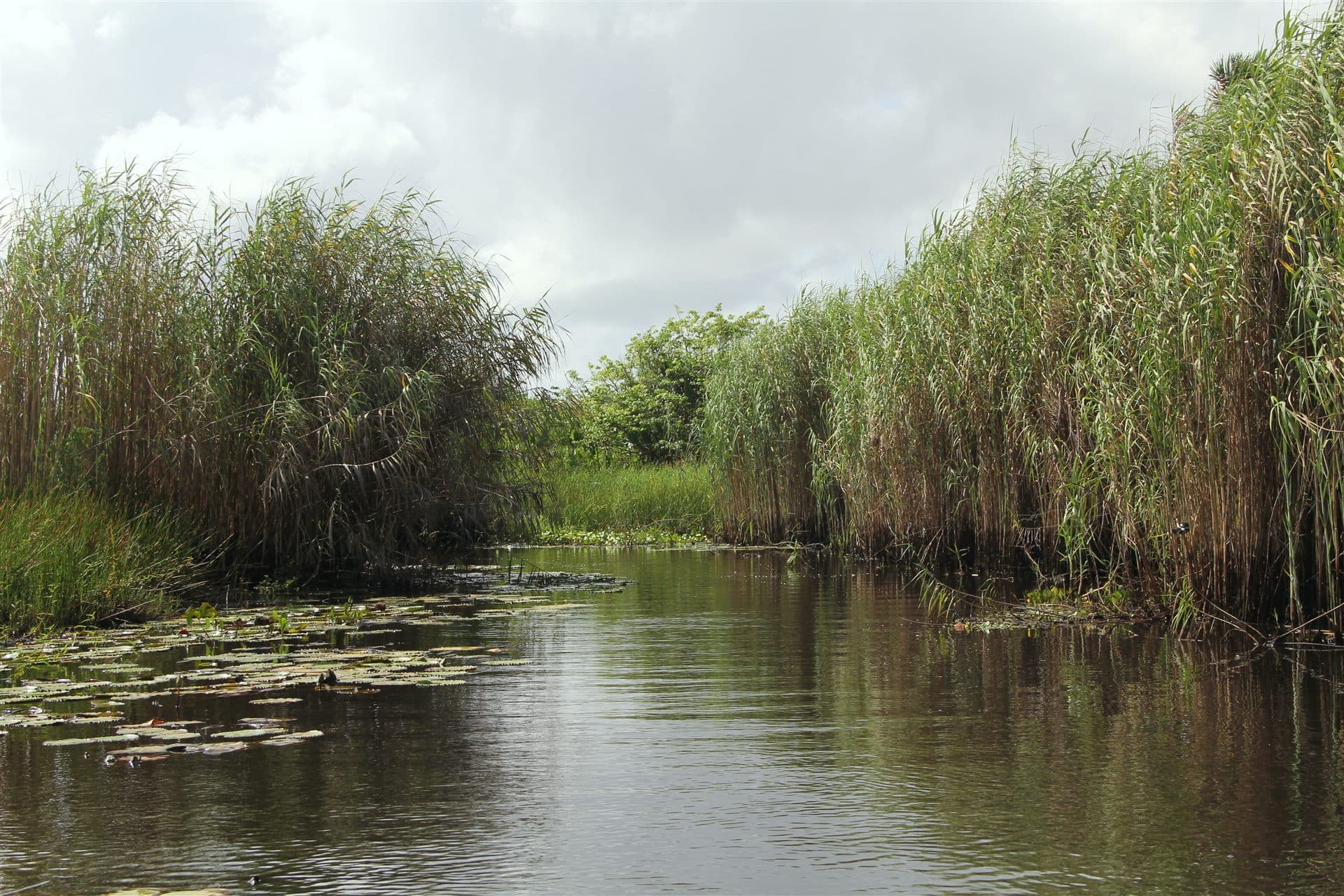
Photo: Shiv Trinidad Skey · Nariva Swamp, Trinidad (CC BY 2.0)
Bush Bush Wild Life Sanctuary is a 1,408-hectare forested island of elevated hardwood rising above the Nariva Swamp on Trinidad's east coast - the Caribbean's largest freshwater wetland and a Ramsar site. Declared a wildlife sanctuary in 1968 under the Conservation of Wildlife Act and gazetted a Prohibited Area in 1989, Bush Bush protects a remarkable refuge of tall mora and silk-cotton forest, moriche palm groves, and the mosaic of swamp and dry-land habitat that supports some of the island's most iconic and threatened wildlife.
Bush Bush Island sits roughly 3 metres above the surrounding Nariva flood plain, an accident of geology that created a uniquely dry forest interior surrounded by freshwater marsh and reed swamp. The forest canopy is dominated by silk-cotton (Ceiba pentandra) and hardwood species interspersed with dense stands of moriche (Mauritia setigera), royal (Roystonea oleracea), and manicole (Euterpe oleracea) palms whose fruits are critical food sources for larger vertebrates. The sanctuary was first brought to scientific attention in 1959 through yellow fever virus lifecycle studies, and the following decade saw coordinated advocacy - backed by a grant from the New York Zoological Society - secure its formal legal protection.
The sanctuary's fauna is the most diverse of any protected freshwater area in Trinidad. Red howler monkeys (Alouatta seniculus) and white-fronted capuchins (Cebus albifrons) range through the canopy, while the West Indian manatee (Trichechus manatus) feeds in the surrounding swamp channels. Blue-and-gold macaws (Ara ararauna), locally hunted to functional extinction, have been the subject of active reintroduction efforts, alongside the naturally resident red-bellied macaw (Orthopsittaca manilatus). The broader Nariva ecosystem records at least 204 bird species, 45 mammals, 39 reptiles, and 19 amphibians.
Despite its dual legal shield - wildlife sanctuary status under COWA plus Prohibited Area classification - Bush Bush has faced persistent encroachment. Illegal squatting, rice and cannabis cultivation in the buffer zones, unlawful livestock grazing, overfishing, timber extraction, and the trapping of parrots and macaws for the pet trade caused measurable degradation through the 1980s and 1990s. A management assessment updated in 2005 by Ducks Unlimited, the T&T government, and the USDA Forest Service mapped priority restoration zones; some former coconut estates have since undergone reforestation. Effective enforcement and sustained funding remain the primary obstacles to long-term recovery.
Why This Matters
Bush Bush is the heart of the Nariva Swamp: a forested island of elevated hardwood, mora, and silk-cotton rising a few metres above the surrounding freshwater marsh, creating a dry-land refuge within the largest wetland ecosystem in Trinidad and Tobago. That modest elevation difference is ecologically decisive. It produces a forest interior radically different from the surrounding swamp, supporting a wildlife community that depends on the combination of dry-land forest and surrounding wetland for everything from nesting sites to foraging grounds to freshwater access. Without Bush Bush, the Nariva ecosystem loses its forest core, and the species that depend on that core lose their stronghold.
The fauna of Bush Bush reads like a roll-call of Trinidad's most iconic and threatened wildlife. Red howler monkeys and white-fronted capuchins range through the forest canopy; West Indian Manatees feed in the surrounding swamp channels; Blue-and-gold Macaws, once hunted to local functional extinction, have been the subject of active reintroduction programmes within the sanctuary. The broader Nariva system records 175 bird species and 45 mammal species. Bush Bush is not a peripheral element of this biodiversity; it is its centre of gravity.
The illegal encroachment that degraded portions of Bush Bush's surrounding buffer zones through the 1980s and 1990s, and the restoration work that has followed, tells a story that is still being written. The Wildlife Sanctuary designation, the Prohibited Area classification, the Ramsar context of the broader Nariva system: these frameworks are not failures when encroachment occurs; they are the tools available for the necessary response. What happened at Nariva is one of the reasons those tools exist.
Legal Protections
This sanctuary is gazetted under the Conservation of Wildlife Act. Hunting, trapping, and disturbance of wildlife within its boundaries is a criminal offence. Penalties include fines and imprisonment. If you witness illegal activity within this sanctuary, report it immediately.
Report a ViolationCurrent Threats
- Illegal squatting and encroachment for rice and cannabis cultivation
- Unlawful livestock grazing within sanctuary boundaries
- Trapping of parrots and macaws for the illegal pet trade
- Illegal timber harvesting and overfishing in swamp channels
- Insufficient enforcement capacity and funding
Primary Sources & Legal Citations
- Conservation of Wild Life Act, Chap. 67:01 · First Schedule, Item 12
- Forests (Prohibited Areas) Order, Chap. 66:01 · Subsection (10)[GN 155/1989 (effective 27 September 1989)]